Fastpitch catcher gear is not a light load. A helmet with a mask, chest protector, leg guards, a catcher's mitt, spare softballs, cleats, and a throw towel can fill a regular softball bag before the first inning. A standard bag may hold the volume on paper, but the dividers are often thin sleeves or single layer panels. Those panels collapse when a chest protector presses against leg guards. The result is a bag that bulges, zippers that fight back, and gear that shifts every time the bag is lifted. An oversized softball bag with reinforced dividers solves a specific problem. It gives bulky gear separate, supported zones instead of one soft cavity.
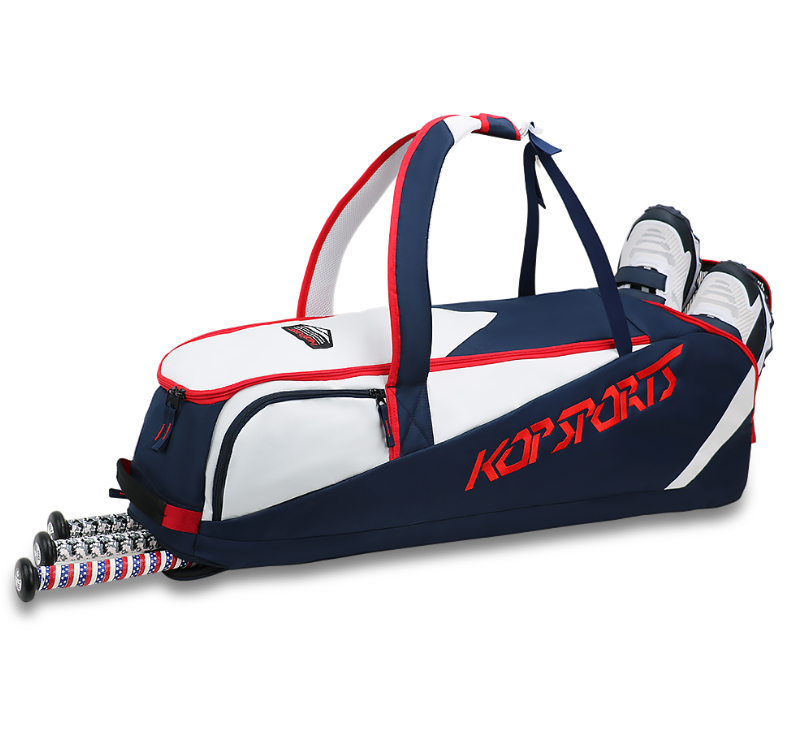
A divider is a structural part, not a pocket liner. In a catcher's bag, it has to resist compression from a chest protector, keep leg guards from folding into the mitt, and protect the mask from pressure. Reinforced dividers usually combine a rigid or semi rigid panel with bound edges and double stitched seams. The panel spreads point loads. The bound edge keeps the panel from fraying at the corner. The stitching keeps the divider anchored to the bag wall. Without those three details, a divider becomes a flap that folds under load. A useful check is to press a loaded chest protector against the divider and watch the seam line. If the panel bows and the seam pulls, the divider is decorative.
Making a bag bigger without changing structure is a common mistake. Extra volume invites more gear, and more gear changes the load path. A fastpitch catcher's bag that carries 40 to 50 pounds needs a base that will not sag, shoulder straps that spread weight, and a handle or wheel system that matches how the bag moves. Reinforced dividers help because they tie the bag walls together. They act like internal braces. When the bag is lifted, the dividers share some of the load with the bottom panel. That reduces the chance of a seam opening at the wheel housing or shoulder anchor. The tradeoff is weight. A heavily reinforced bag will feel stiffer and slightly heavier empty. For a catcher who carries a full set of gear, that stiffness is usually worth it.
At a high school field in a rainy spring season, a catcher's bag was pulled after two weeks of use. The leg guards had been shoved in wet, and the chest protector was stacked on top. The divider between them had collapsed at the bottom corner. The zipper had started to separate near the end. A closer look showed a single layer nonwoven panel with no bound edge and a short bar tack at the anchor point. The fix was not a new bag design. It was a PE board panel with bound edges and a longer anchor stitch. After the change, the same load pattern held for the rest of the season. That case is a reminder that divider failure usually starts at an edge, not in the middle of the panel. Standards such as ASTM D5034 for grab tensile and ASTM D1683 for seam slippage give a useful baseline for material and seam checks. They do not replace a loaded field test, but they catch weak lots before they reach the line.
The table below compares typical construction points. The numbers are representative of common production ranges, not a promise for every design.
| Feature | Standard softball bag | Oversized bag with reinforced dividers |
|---|---|---|
| Main compartment | Single cavity with thin sleeves | Three to four supported zones |
| Divider panel | Single layer nonwoven or foam | PE board or dense foam with bound edge |
| Divider anchor | Short bar tack | Double row stitch plus bar tack |
| Base structure | Single layer with piping | Reinforced base panel with foot pads |
| Typical load | 20 to 30 lb | 40 to 55 lb |
| Common failure point | Zipper end and bottom corner | Anchor stitch and wheel housing |
| Best use | Light practice load | Full catcher set, travel, wet gear |
A catcher's routine is not a straight line. Practice gear goes in wet. Game gear goes in clean. Travel gear gets stacked in a car or trailer. An oversized softball bag with reinforced dividers fits the full set routine, especially when the bag has a wheeled base or a wide shoulder harness. It is less useful for a player who carries only a mitt and a helmet to a short practice. The honest limit is that a larger bag can be awkward on stairs, sand, or crowded dugouts. Reinforced dividers also add cost and a little empty weight. The design decision should follow the load, not the label. KOP builds sports bag programs at scale, with annual output above 6,000,000 pieces, about 40% wheeled bags, thousands of skilled workers on sports bag lines, and a specialized roller equipment bag facility focused on durable materials and heavy duty construction. That kind of capacity matters when a catcher's bag has to hold its shape through a full season of wet gear and heavy loads.

 EN



 Hot News