A lacrosse bag takes a beating that few sports bags see. Sticks, helmets, pads, cleats, water bottles, and whatever else gets shoved in after a rainy practice all ride together in one package. The bag gets dragged across parking lots, tossed into team vans, stacked in equipment rooms, and left in the sun or the cold. When a buyer compares a lacrosse bag from one supplier to another, the fabric and zipper get most of the attention. The process that put those parts together matters just as much. A strict quality control system is not paperwork for its own sake. It is the difference between a bag that survives a season and one that fails in the first month. The visible product is only the end of a chain that starts with material checks and ends with a final inspection before release.
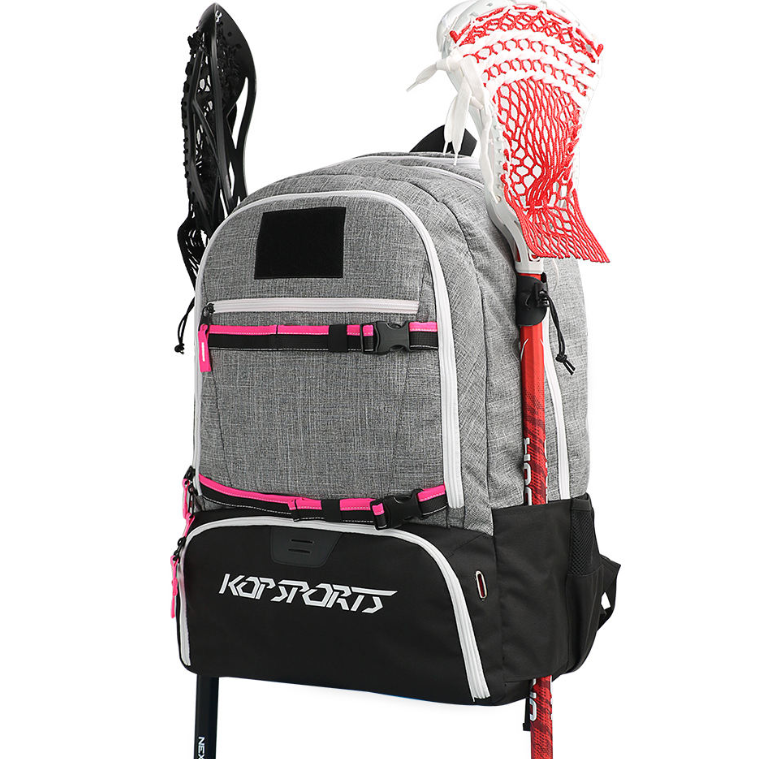
Cheap bags usually fail in predictable places. Stitching pulls out at the shoulder strap anchor. The bottom panel abrades after repeated contact with concrete. Wheel housings crack when a loaded bag rolls off a curb. Zipper sliders jam because the tape was not stabilized. None of these failures show up in a photo or a sample review. They show up after the order ships. For a team dealer or a club buyer, the cost is not just the replacement bag. It is the return shipping, the angry coach, the lost repeat order, and the time spent sorting out who pays for what. A factory with a real QC system catches those risks earlier, when a batch of webbing or a run of stitching can still be corrected. A factory without one usually finds out from the customer, which is the most expensive way to learn.
A useful QC program is specific. Generic claims about inspection do not tell a buyer much. On a lacrosse gear bag, the checks usually fall into a few buckets: incoming material, cutting and stitching, hardware and wheel assembly, and final function. Incoming fabric gets checked for weight, coating consistency, color matching, and defects. Webbing and zippers get pull tested and cycled. Stitching gets checked for stitch density, seam alignment, and backtacking at stress points. Wheeled bags get rolled, lifted, and tilted to confirm the frame and wheel housing hold up. The final inspection should include a full bag load test, handle pull, and zipper cycle. A strict system also controls who signs off and what happens when a lot fails. That last part is where many factories get vague.
| QC area | Weak process | Strict QC system |
|---|---|---|
| Incoming fabric | Visual check only | Batch records, defect limits, color and coating checks |
| Stitching | Spot check at line end | Inline checks at stress points and backtack verification |
| Wheel assembly | Roll test after packing | Frame, housing, and loaded roll test before packing |
| Final release | Sample pulled from finished lot | Defined inspection plan with hold and rework rules |
A spec sheet can promise a tough fabric and a smooth zipper. Consistency is harder. One roll of coated polyester can behave differently from the next, especially in coating adhesion and flex resistance. If the factory does not track material lots, a bag made in month one may not match a bag made in month six. That matters for teams and dealers who reorder. It also matters for wheeled bags, where the frame, wheel housing, and base panel have to work as a system. Standards such as ASTM D5034 for fabric tensile strength and ASTM D1683 for seam strength are commonly cited in soft goods testing. A QC program should map its checks to recognized methods like those rather than inventing pass or fail rules on the fly. The standard itself does not make a bag good. Using it consistently does.
A club order for a university program in the Pacific Northwest once hit a snag that a sample review would have missed. The first production run of wheeled lacrosse bags looked fine on the table. During a loaded roll test on a rough concrete ramp, the lower frame began to flex more than expected near the wheel housing. The issue traced back to a change in the base panel supplier. The material met the stated thickness, but its stiffness was different. Because the factory ran loaded roll tests before packing, the affected lot was held before shipment. The fix was a revised base panel and a tighter incoming check. No customer ever saw the bad batch. That is the point of a strict system. It moves the failure to the factory floor, where it belongs, instead of the team parking lot.
A clean sample proves that a factory can make one good bag. It does not prove that every bag in a production run will match it. Buyers should ask how material lots are tracked, how inline stitching checks are recorded, and what happens when a lot fails. A factory that can show those answers is safer than one that only talks about materials. The same logic applies to capacity. Large output means nothing without controls. Kop Sports runs a production operation built around standardized testing and strict quality control before release, with experience in wheeled bags and sports bag lines. That kind of setup does not guarantee a perfect bag, but it makes repeatable checks part of the process instead of an afterthought.

 EN




 Hot News