A wheeled lacrosse bag packed for a tournament is not a gentle object. Sticks, helmets, pads, cleats, and water bottles stack up fast, and the bag gets lifted by one handle, dropped off a tailgate, and rolled over whatever surface the venue happens to offer. Every one of those actions sends force through the frame, the base panel, and the wheel housing. A lacrosse bag built for wheeled transport lives or dies on how that force travels through the structure. Structural stability is not a cosmetic selling point. It is the property that keeps the bag tracking straight and the gear inside protected after a season of real use.
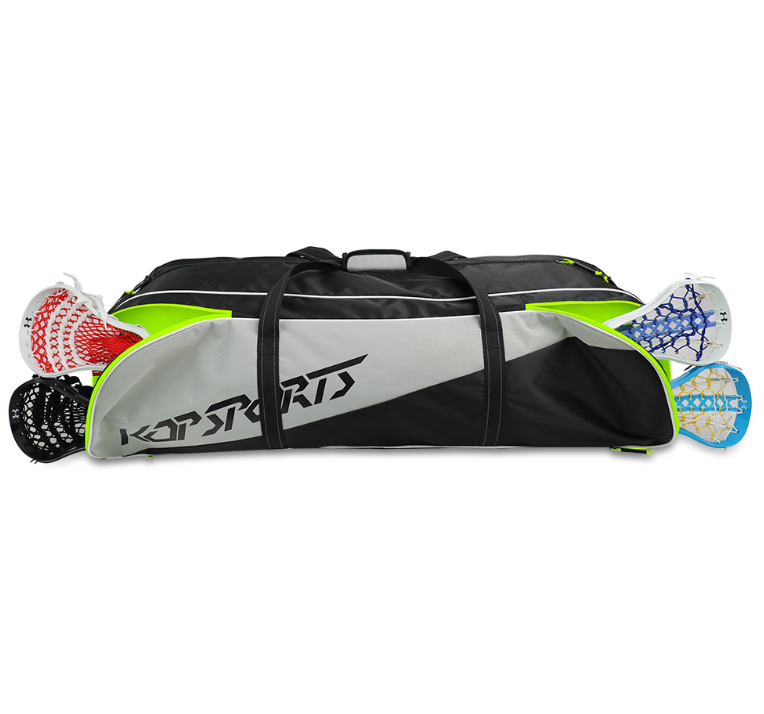
Loaded wheeled bags fail in a sequence, not all at once. The base panel flexes first under the weight of gear. That flex transfers stress to the wheel housing mounting points. If the housing is fixed to a panel that moves, the screws or rivets work loose. Once the housing shifts, the bag tracks poorly and the frame twists. The handle anchor sits at the other end of the same chain. A handle that pulls against a soft frame concentrates force at the stitching and the frame joint. Failures feel sudden to the user, but the sequence usually starts weeks earlier with a base panel that flexes more than it should.
| Load path stage | Weak build behavior | Stable build behavior |
|---|---|---|
| Base panel | Flexes under load, moves the housing | Holds flat, spreads load to the frame |
| Wheel housing | Mounting points loosen or crack | Stays fixed through curbs and ramps |
| Lower frame | Twists on uneven ground | Keeps alignment under rolling load |
| Handle anchor | Stitching pulls, joint deforms | Force spreads into the frame |
The frame does not carry the load alone. The base panel and the wheel housing share the job, and the three parts have to match in stiffness. If the base panel is stiff and the frame is light, the failure moves to the frame joints. If the frame is heavy and the base panel is soft, the bag sags and the housing tilts. A well-designed wheeled bag matches stiffness across the system so the load travels without a weak link. This is why structure is an engineering question rather than a materials list. Two bags can use the same fabric and the same wheels and still behave very differently once loaded.
A high school program in a cold northern state once ordered a run of wheeled bags for a winter travel schedule. The samples looked solid, and empty bags rolled smoothly across a shop floor. Then the club ran a loaded roll test on a sloped concrete ramp with gear inside. The lower frame flexed near the wheel housing more than expected. The cause traced back to a base panel lot change. Thickness matched the spec, but stiffness did not. The lot was held before shipment, the base panel was revised, and the incoming check was tightened to include a stiffness check. No customer ever received the affected batch. That outcome is the whole point of structural testing. It moves the failure to the factory floor instead of a parking lot in January.
Soft goods testing offers recognized methods that map to structural checks. ASTM D5034 covers fabric tensile strength, and ASTM D1683 covers seam strength. Those tests do not measure frame stiffness directly, but they show whether the materials holding the structure together can carry the load. For wheeled bags, a loaded roll test, a handle pull test, and a drop test on the wheel housing are more direct. Packaging standards such as ASTM D5276 for drop testing of loaded containers provide a useful reference for how to run the drop in a repeatable way. The standard is a starting point, not a guarantee. Running the test on each production lot and acting on the results is what separates a stable bag from a claim on a spec sheet.
Buyers can separate a stable build from a cosmetic one with a few direct questions. How is the base panel supported, and is there a frame that ties the handle anchor to the wheel housing? What happens to the housing under a loaded drop? Has a finished bag been tested loaded, on a slope, with gear inside? A factory that answers with test records is safer than one that only describes fabric weight. Capacity matters, but only when it comes with controls. Kop Sports runs a production operation built around standardized testing and strict quality control before release, with a large share of output in wheeled bags and sports bag lines. That setup does not guarantee every bag survives every abuse, but it makes structural checks a routine part of the process instead of a last-minute inspection.

 EN




 Hot News