Most buyers judge a baseball bag by its look, its compartments, or how smoothly the wheels roll in a store aisle. That first impression tells almost nothing about what happens in week thirty of a travel season, when the bag has been thrown into a van, rained on, overpacked with helmets and catcher's gear, and dragged across parking lots. A standardized testing process is the part of manufacturing that answers those later questions. It means every single bag goes through the same predefined assessments before it leaves the facility, not just a random sample pulled from the line. Material durability, craft accuracy, and structural stability get checked against uniform criteria, and a strict quality control system watches the testing itself so results stay consistent from one batch to the next. For a baseball bag, that consistency matters more than any single lab result, because the real failure modes show up in the field, not on a spec sheet.
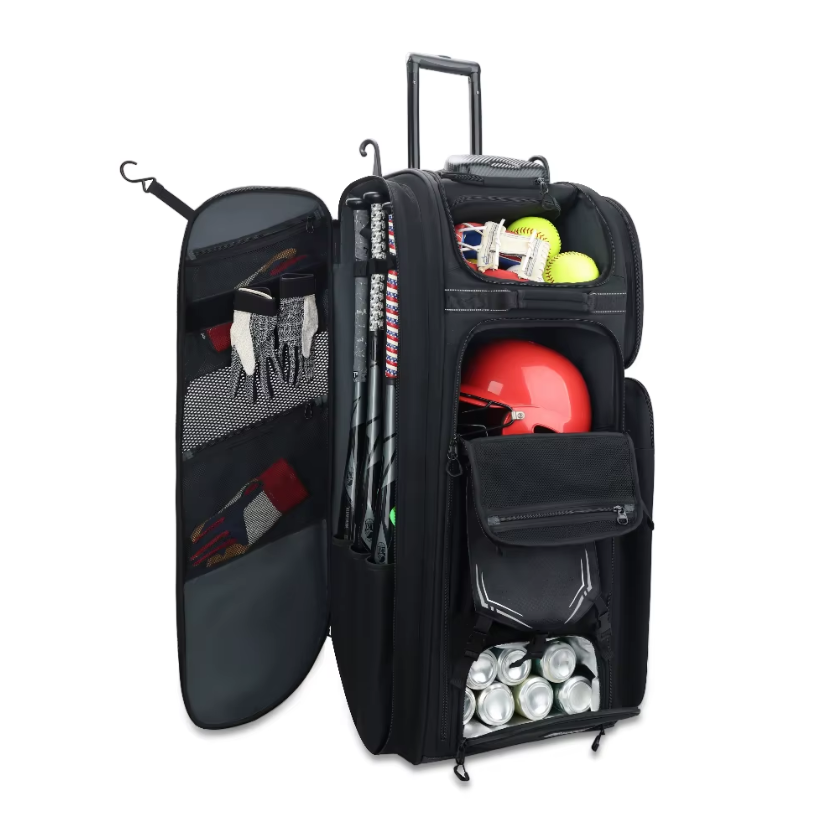
Fabric strength is the easy part to test. A tensile test on the shell material gives a clean number, and most factories stop there. The harder questions involve seams, zippers, and the points where handles meet the body. A standardized process typically runs abrasion cycles on high-wear zones, repeated open-and-close counts on zippers under load, and static and dynamic pull tests on straps and handles. According to ASTM D5034, the standard test method for breaking strength and elongation of textile fabrics, grab tensile results give a baseline, but the seam efficiency percentage is what actually predicts field performance. A shell fabric rated at 600 denier means little if the seam loses forty percent of that strength at the stitch line. Standardized testing catches that gap before the bag ships.
Here is a comparison that shows how testing depth changes outcomes across production runs:
| Testing dimension | Ad hoc sampling | Standardized testing process |
|---|---|---|
| Material checks per batch | 1 to 2 random units | Every unit assessed against predefined criteria |
| Zipper cycle testing | Occasional, undocumented | Fixed cycle count under load, logged per batch |
| Seam strength verification | Visual inspection only | Grab tensile and seam efficiency measured |
| Wheel and handle durability | Spot checks | Dynamic pull and roll tests on every lot |
| Documentation trail | Inconsistent | Uniform records reviewed before release |
The practical difference shows up when a supplier runs multiple lines. Without a fixed protocol, one shift may pass a batch that another shift would reject. Standardized testing removes that variability. A buyer sourcing a baseball bag from a high-volume facility gets the same assessment standard on the first order and the five-hundredth.
A sports equipment distributor once handled a return surge on wheeled bags after a humid summer season. The shells held up fine, but zipper sliders were corroding and sticking on bags stored in garages and dugouts. The root cause traced back to a salt-spray exposure gap in the incoming material check. The fix was not a new material but a revised test protocol: salt-spray cycles were added to the incoming inspection for metal hardware, and the pass threshold was tightened. Returns dropped sharply the following season. That case illustrates why standardized testing earns its keep. It is not about catching a catastrophic defect. It is about finding the slow, environment-specific failure that only shows up after months of real use, and building a repeatable check so it does not recur.
Wheeled bags carry a different stress profile than carry bags. The frame, the wheel housing, and the telescoping handle take repeated impact and torsion loads. A standardized process for wheeled models usually includes a loaded roll test over a simulated curb and gravel surface, a handle extension and retraction cycle count, and a drop test from a defined height with a full load. ISO 10748 covers zipper strength and slider lock reliability, and it is a useful reference point when specifying hardware tests. The honest limitation here is that no lab test fully replicates a teenager dragging a bag across a gravel parking lot at an angle. What standardized testing does is narrow the gap between lab conditions and field abuse, and flag the weak points before they become return claims.
A few direct questions separate a real testing program from a marketing claim. Ask for the specific test methods used on shell fabric, seams, zippers, and wheels, not just a pass or fail statement. Ask how many units per batch go through full assessment versus spot checks. Ask whether the quality control system reviews the testing records before release, and who signs off. Ask for a sample of the documentation trail. A supplier running a genuine standardized process will have answers ready. One that does not will pivot to price and lead time. For buyers sourcing a baseball bag at volume, those questions are worth more than a catalog photo.
KOP Sports runs a production line with thousands of skilled workers and an annual output exceeding six million bags, forty percent of them wheeled. The facility pairs professional roller equipment with a standardized testing process and a strict quality control system that reviews every single bag before release. For buyers who want documented consistency rather than verbal assurances, that combination is the practical starting point.

 EN

 Hot News