Hockey gear is heavy, wet, and awkward. A wheeled ice hockey bag hauls skates, pads, helmets, and sometimes a spare stick or two, often across wet rink floors, slushy parking lots, and concrete stairs. The base of the bag takes the worst of it. A soft bottom sags under load, the wheels misalign, and the fabric starts to rub through at the corners. That is where rigid bottom rails and corner armor change the story. They turn a soft-sided bag into a structure with a defined load path. The rails carry weight across the base and down to the wheels. The corner armor absorbs impacts and abrasion at the points where the bag meets the ground. Together they give a wheeled hockey bag a stability that a plain fabric bottom cannot match. The bag still flexes, but it does not collapse into a shapeless sack.
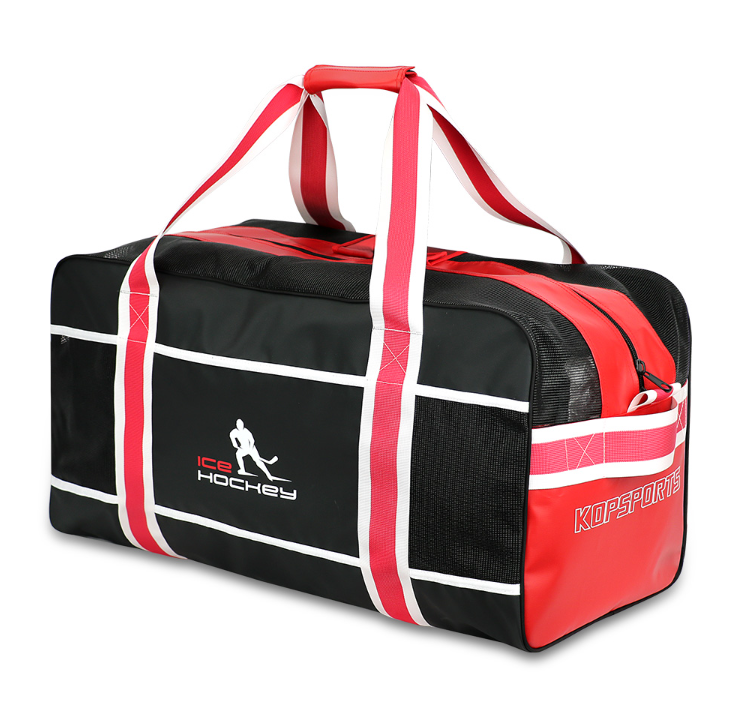
A rigid rail is not just a stiffener glued to the bottom. It is a frame element. Good designs use molded plastic, aluminum, or a composite rail that runs along the length of the base and ties into the wheel housing. When the bag is loaded, the rails distribute the weight so the bottom panel does not bow downward between the wheels. That distribution matters because a sagging bottom pulls on the side seams and the zipper line. Over time, a sagging bag develops a curved shape that never sits flat again. Rails prevent that creep. They also keep the wheels square to the ground, which reduces rolling resistance and side-to-side wobble. A bag with rails tracks straighter and feels more controlled when pulled behind a player. The tradeoff is stiffness, and a stiff base adds weight. That is a fair trade for a bag that has to survive a full season of rink life.
Corners fail first. A wheeled bag gets dragged over curbs, dropped on arena steps, and shoved into equipment racks. The corners take direct abrasion and impact. A reinforced corner armor panel, usually a TPU or rubberized cap stitched or bonded over the corner, spreads that abuse across a larger area. Without armor, the fabric at the corner wears through, the padding compresses, and the corner starts to collapse. A case from a Minnesota club program shows the pattern clearly. The team used standard wheeled bags without corner armor for a fall season. By week eight, three bags had worn through at the rear corners, and one had a wheel housing pulling loose. The replacement bags had rigid rails and molded corner armor. Those bags finished the season, went through a winter of indoor practices, and showed only surface scuffs at the corners. The gear load did not change. The base structure did. That is the practical difference between a bag that lasts and a bag that becomes a backup.
No structural feature comes free. Rigid rails add weight, often 200 to 400 grams depending on material and length. Corner armor adds a little more. The bag also becomes less collapsible, which matters for storage in a car trunk or a locker. A rail system that is bolted on rather than integrated can crack at the mounting points, so the design has to treat rails as part of the shell, not an add-on. Another honest limit is repairability. A molded corner cap is harder to replace than a fabric patch. The promise is not indestructibility. A bag with rails and armor still cannot survive being dragged over sharp metal or used as a step. What it can do is resist the daily wear that kills soft-bottom bags, and do it without constant patching.
Structural stability can be compared with simple field measurements and standard material tests. ASTM D5034 covers grab tensile strength for fabrics and seams, and ASTM D4157, the Wyzenbeek test, measures abrasion cycles. The table below uses representative field observations from club and team use, not a certified lab report. The numbers are approximate and vary with load, surface, and bag size.
| Bottom design | Sag under full load (mm) | Corner wear after 12 weeks | Wheel mount stability | Common field result |
|---|---|---|---|---|
| Single-layer fabric bottom | 18 to 25 | Visible wear through at corners | Loose after 8 weeks | Base failure in one season |
| Foam-padded bottom, no rails | 12 to 18 | Surface scuffs, some fraying | Slight wobble | One season with patching |
| Rigid rails, no corner armor | 5 to 9 | Corner wear but no holes | Stable | Two seasons with minor repairs |
| Rigid rails plus molded corner armor | 3 to 6 | Surface scuffs only | Stable and square | Multiple seasons of team use |
The pattern is clear. Rails control sag and wheel alignment. Corner armor controls abrasion and impact. Both together produce a base that holds its shape. The data also shows the limit: no design eliminates wear entirely. It just moves the failure point much further out.
A rail and armor design only works if the factory builds it consistently. Rail mounting holes that drift by a few millimeters create stress points. Corner armor that is stitched unevenly leaves gaps. KOP runs high-volume bag production with an annual output of more than 6,000,000 pieces, including a large share of wheeled bags, and every unit goes through a standardized testing process before release. Material durability, craft accuracy, and structural stability are checked under a strict quality control system. For a wheeled ice hockey bag, that discipline shows up in rail mounts that line up with the wheel housing, corner armor that sits flat without puckering, and a base that stays square after repeated loading. The result is not a bag that never wears out. It is a bag whose structural stability is a repeatable property, not a lucky batch.

 EN




 Hot News