A travel lacrosse bag has to do more than carry a helmet, cleats, and a water bottle. The stick is the awkward part. It is long, has a head that does not like being crushed, and often stays wet or muddy after a game. External stick holders move that awkward cargo to the outside of the bag, where it can be secured without stealing space from the main compartment. That single design change affects packing order, gear hygiene, and how quickly a player can get through a parking lot or bus aisle. The benefit is not cosmetic. It is a practical answer to a daily handling problem.
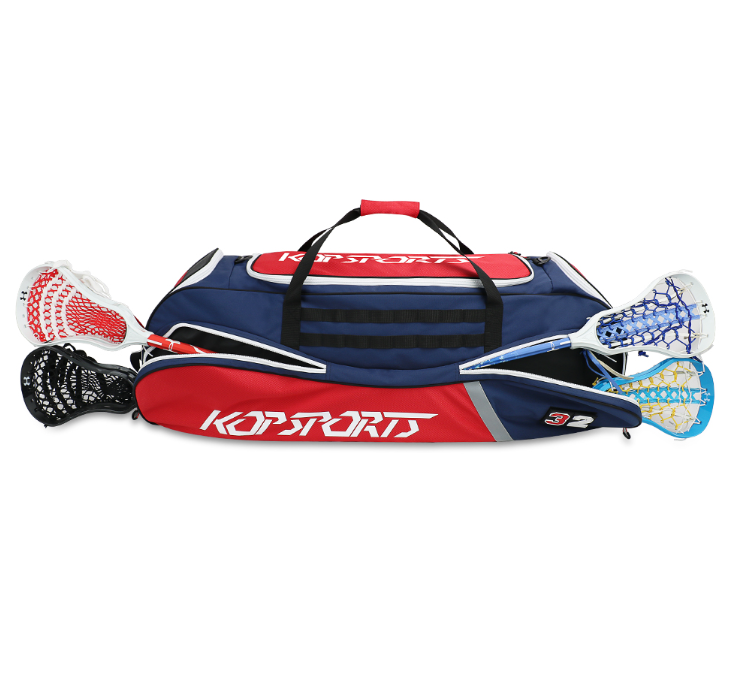
A short crosse typically runs about 40 to 42 inches, while a long crosse for field play can reach 52 to 72 inches depending on position and rules. The head adds a wide, stringed shape that can bend or warp if heavy bags press on it for hours. Inside a main compartment, a stick becomes a lever. Every turn of the bag pushes the head against a helmet or a cleat. External holders change the load path. Straps or sleeves take the stick's weight and keep the head away from hard gear. The result is less point pressure on stringing and less chance of a warped sidewall. The same logic explains why stick sleeves on a lacrosse bag should be shaped, not just long. A loose tube lets the head slide and knock against the bag frame.
The practical gains show up in small moments. A player can slide a stick into an external holder without opening the main compartment. Wet gloves and a jersey can stay in a separate pocket. A coach can count sticks at the bus door without asking players to unpack. Three common benefits:
Faster loading and unloading at fields with limited parking.
Better separation between wet gear and dry equipment.
Less digging through the main compartment for a stick, mouthguard, or ball.
Those gains sound minor until a team does them twenty times in a weekend. A lacrosse bag with well placed holders also gives players a repeatable packing routine, which matters when a missed stick means a missed warmup.
Travel conditions expose the weak points. A bag that works in a car trunk may fail on a conveyor belt if the external holder snags or the stick takes direct impact. External holders are strongest for bus, car, and club van travel, where the bag stays in sight and can be laid flat. For airline checked baggage, a hard case or a removable stick sleeve is often safer. A useful comparison:
| Factor | Stick inside main bag | External stick holder | Practical note |
|---|---|---|---|
| Main compartment space | 8 to 12 liters lost to a stick | Main space stays open | More room for helmet and pads |
| Access time | Unzip, dig, rezip | Slide in or clip on | Faster at field and bus |
| Head pressure | High when bags stack | Low if holder is shaped | Stringing stays straighter |
| Wet gear separation | Poor to fair | Good with drain holes | Mud stays away from dry gear |
| Weather exposure | Protected | Exposed unless covered | Rain cover helps |
| Airline check | Better protected | Snag and impact risk | Hard case is safer |
The table is not a scorecard. It is a reminder that the right choice depends on how the bag travels. A travel lacrosse bag used mostly for weekend league play has different demands from one that flies to tournaments.
During a spring tournament circuit in the Pacific Northwest, a youth club moved twenty four players through three venues in two days. Sticks stored inside the main bags pressed against helmets, and several heads came out with bent sidewalls. The club switched to travel bags with external holders, drain gussets, and wide webbing straps. The change did not make the bags waterproof, and the sticks still needed wiping at night. It did keep wet mesh away from dry helmets and made stick checks at the bus door much quicker. That kind of field feedback is more useful than a lab photo because it shows where a feature earns its place and where it needs a cover.
External holders live or die on attachment details. Look for bar tacked webbing, replaceable buckles, and a base that spreads load across the bag panel. A holder that hangs from one seam will sag. Drainage matters too, because a wet stick can drip into a zipper or a helmet. For distribution testing, ASTM D4169 is a recognized practice for shipping container performance, and its drop and vibration cycles are a reasonable reference for how a loaded bag should survive transport. No soft bag is indestructible, and an external holder does expose sticks to weather. That tradeoff should be stated plainly. A buyer should also test the holder with a real stick, loaded bag, and gloved hands.
For volume programs, repeatable construction matters as much as the first sample. Kops produces more than 6,000,000 bags annually, with about 40% wheeled bags, and runs each bag through a standardized testing process before release. That kind of capacity and quality control helps when a lacrosse bag line needs consistent webbing strength, stitching, and supply follow through across seasons.

 EN




 Hot News