A helmet does not stop protecting a player the moment it leaves the field. It still has to survive the ride home, the equipment room, the back of a car, and the pile of gear that builds up after a tournament weekend. That is where a helmet bag earns its keep. The outer shell is the part that takes the hits, scrapes, and drops before they ever reach the helmet inside. A soft bag with a thin shell might look fine on a shelf, but it does little when a loaded gear bag slides off a bench or gets crushed under a stack of equipment. Heavy-duty outer shells are not about making a bag look tough. They are about creating a barrier that spreads impact energy across a wider area so the helmet does not take a concentrated blow.
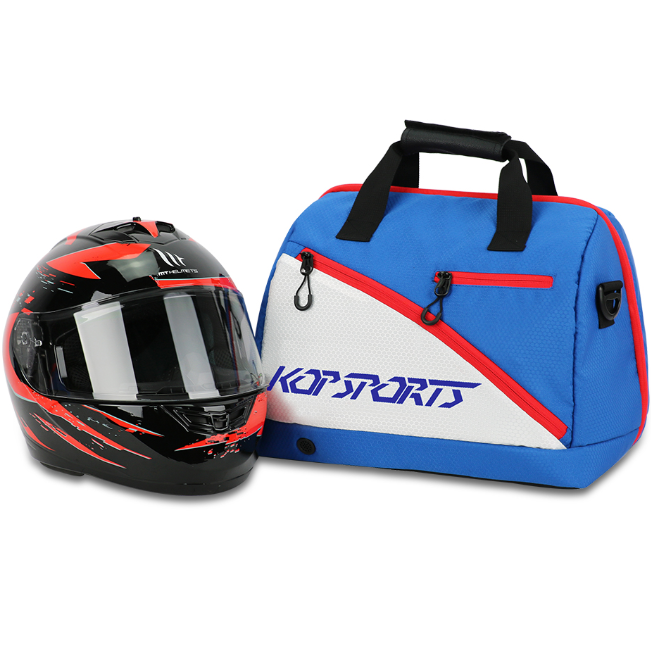
Most helmet damage does not happen in a dramatic crash. It happens in small, repeated events. A bag gets dropped from waist height onto concrete. Another bag lands on top of it in a van. A car trunk closes on a corner. A player drags the bag across a parking lot and the shell scrapes against a curb. Each event is minor on its own. Over a season, those minor events add up. The shell has to resist punctures, abrasion, and compression without transferring the force straight to the helmet shell or face mask. That is a different job from being waterproof or looking clean. The outer layer needs enough stiffness and thickness to bridge over the helmet's shape and enough toughness to avoid tearing when something sharp presses against it.
When an object strikes a bag, the energy has to go somewhere. A thin shell deforms locally and passes most of the force through to the helmet at a small contact point. A heavier shell distributes that force over a larger area and absorbs some of the energy through controlled deformation. The material matters, but so does the structure. A laminated shell with a foam or EVA backing can spread load better than a single layer of fabric. A molded panel can hold its shape under compression. The goal is not to make the bag rigid like a hard case. The goal is to create a shell that flexes just enough to absorb a hit without collapsing onto the helmet. That balance is why shell design is a structural question, not just a fabric choice.
| Shell type | Behavior under impact | Protection level for helmet |
|---|---|---|
| Thin single-layer fabric | Local deformation, force passes through | Low, helmet takes concentrated load |
| Padded fabric shell | Some spread, limited stiffness | Moderate, depends on padding density |
| Heavy-duty laminated shell | Wider load spread, controlled flex | High, reduces concentrated force |
| Rigid molded shell | Minimal deformation, hard stop | High but can transfer shock if too stiff |
A club program in the Northeast once ran into a shell problem that only showed up in real transport. The first batch of helmet bags used a padded fabric shell that felt substantial in hand. During a loaded drop test from about waist height onto a concrete floor, the shell compressed at the corner and the helmet inside shifted enough to contact the bag wall. The helmet was not damaged, but the test showed the shell was not spreading the load as intended. The fix was a laminated shell with a denser backing panel at the corners and base. The revised bag passed the same drop test with less shell deformation and no helmet contact. That case is a good reminder that a shell can feel thick and still fail to manage impact energy. Testing the finished bag, not just the material, is what catches the difference.
Packaging and transport testing has established methods that apply well to helmet bag shells. ASTM D5276 covers drop testing of loaded containers, and ASTM D4169 provides a framework for distribution cycle performance testing. Those standards were written for shipping containers, not sports bags, but the logic carries over. A loaded bag dropped from a defined height onto a defined surface should show how the shell behaves under impact. For helmet bags, a useful test also checks whether the helmet inside moves enough to contact the bag wall. A shell that passes a drop test without transferring load to the helmet is doing its job. A shell that only looks thick has not been proven. The standard does not make a bag protective. Running the test on production lots and acting on the results does.
Buyers can ask questions that separate a real heavy-duty shell from a cosmetic one. What is the shell construction, and is there a backing layer at the corners and base? Has the finished bag been drop tested with a helmet inside? How does the shell behave when a loaded bag is compressed under another bag? A factory that can answer with test records is safer than one that only describes fabric weight. Capacity matters, but only when it comes with controls. Kop Sports runs a production operation built around standardized testing and strict quality control before release, with experience across sports bag and wheeled bag lines. That setup does not guarantee every bag will survive every impact, but it makes shell and drop checks a routine part of the process instead of a claim on a spec sheet.

 EN





 Hot News