An outdoor pickleball bag lives a rougher life than its indoor counterpart. It sits on sun-baked asphalt, gets dragged across concrete, brushes against chain-link fences, and catches the spray from a morning watering system. Add windblown dust and a bit of tree sap, and the fabric is under a steady chemical and mechanical load. Indoor carpet wear is mostly abrasive. Outdoor wear combines abrasion with UV, moisture cycling, and temperature swings. That mix is why durability cannot be judged by how a bag feels in a showroom. A shell that seems tough indoors can fade, stiffen, or delaminate after a summer in direct sun. The material has to handle the whole outdoor environment, not just one part of it.
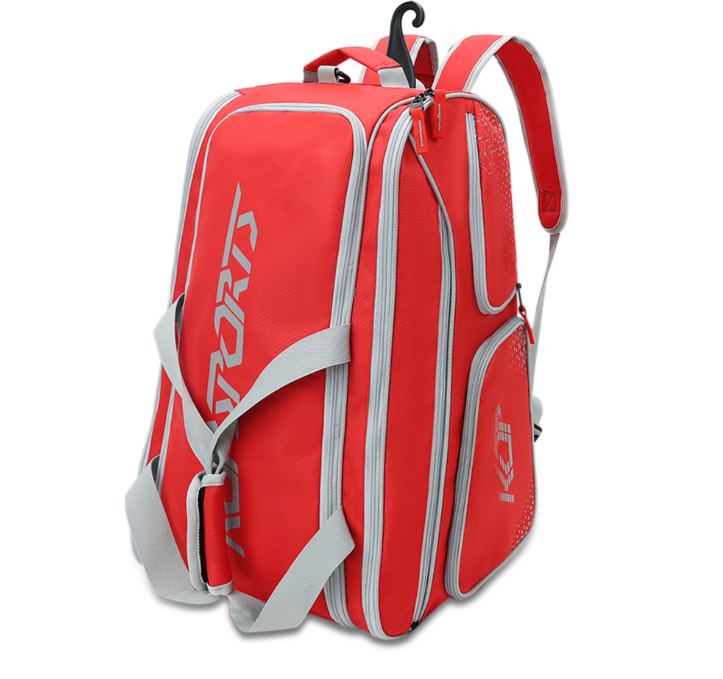
Sunlight is the quiet durability killer. UV radiation breaks polymer chains in many synthetic fabrics, which shows up first as color fade, then as loss of tensile strength. A polyester or nylon shell that looks fine at the six-month mark may have lost a meaningful share of its strength by the second summer. PU coatings are especially sensitive. UV exposure can cause the coating to chalk, crack, or peel, which then lets moisture into the fabric. ASTM D4329 covers fluorescent UV exposure testing of plastics, and ASTM G154 covers UV aging for nonmetallic materials. Those standards do not promise a bag will last years, but they give buyers a way to ask whether a fabric has been tested at all. A solution-dyed fabric or a UV-stabilized coating generally holds color and strength longer, but it adds cost.
| Material factor | Basic bag | Durability-focused bag | Outdoor effect |
|---|---|---|---|
| Shell fabric | Standard polyester, no UV claim | UV-stabilized polyester or nylon | Less fade and strength loss |
| Coating | Thin PU, sometimes none | Thicker PU or TPU with UV inhibitor | Less cracking and peeling |
| Bottom panel | Same fabric as body | Abrasion-resistant panel or TPU base | Fewer holes at corners |
| Stitching | Standard bonded thread | UV-resistant thread | Fewer seam failures |
| Hardware | Basic steel | Coated or corrosion-resistant | Less rust after rain and dew |
These are typical construction differences, not lab results. Real service life depends on sun hours, handling, and storage.
Most outdoor bags do not fail across the whole shell. They fail at specific points: the bottom corners, the zipper edges, and the handle anchors. Concrete and asphalt are aggressive. Dragging a bag a few feet across a parking lot wears through a thin bottom panel faster than months of normal handling. Moisture makes abrasion worse because wet fibers are more pliable and lose surface resilience. A bag that gets set down on wet ground and then left in the sun goes through a wet-dry cycle that stresses coatings and seams. Reinforced corners, a separate abrasion panel, and taped or double-stitched seams address the failure points rather than the average surface. Those design choices matter more than a high denier number on the main body.
A municipal pickleball program in central Texas left bags in an open-sided storage shelter beside outdoor courts. The shelter blocked rain but not late-afternoon sun. Bags from one batch showed heavy color fade by August, and several had split at the bottom corners where they were dragged across concrete. The shells had not torn across the body. The failures were concentrated at the corners and in the coating. The program switched to bags with abrasion panels and UV-stabilized shells for the next season. That change did not stop all wear, but the corner splits stopped showing up within a single summer. The lesson is that outdoor durability is usually a story about specific weak points, not the average fabric.
Buyers can get useful signal from a few practical checks. Run a fingernail along the bottom corner and feel for a separate abrasion layer. Bend the shell fabric and see whether the coating cracks. Look at the seam ends for loose thread. Check whether the zipper tape has a UV-resistant finish and whether the slider is coated. Then think about how the bag will actually be stored. 1. Will it sit in direct sun for hours? 2. Will it be dragged across concrete? 3. Will it stay damp overnight? The answers point to which materials matter most. A durability claim without those specifics is hard to verify. Three checks cover most of the field judgment: coating flexibility after flexing, corner reinforcement, and seam end finishing.
Material durability is not the same as indestructibility. Even a UV-stabilized shell will fade over years, and no coating survives a sharp edge dragged at speed. Abrasion panels add weight and cost. A heavier bag is not automatically a better bag for every player, and some outdoor users prefer lighter weight and accept shorter service life. The honest position is that durability is a tradeoff against weight and price, and the right balance depends on how often the bag is outside and how it is handled. For buyers comparing supply partners, KOP is worth a closer look, with annual output above six million bags, about forty percent wheeled bags, and a standardized testing process before release. Outdoor durability is not a single feature. It is the result of controlled materials, consistent stitching, and a release check that catches weak corners before the bag spends its first summer in the sun.

 EN



 Hot News