Most players set a pickleball bag on the ground beside the court and think nothing of it. Then a stray ball rolls through the puddle next to the bag, or a player backing up for a lob steps on the strap. A built-in fence hook moves the bag off the ground and onto the fence, which keeps it out of foot traffic and away from wet concrete. The feature looks minor in a product photo. In practice, it changes where the bag lives during a session. The hook also keeps the main compartment at waist height, so reaching for a ball or a towel does not require bending down between points. That small convenience adds up over a two-hour session.
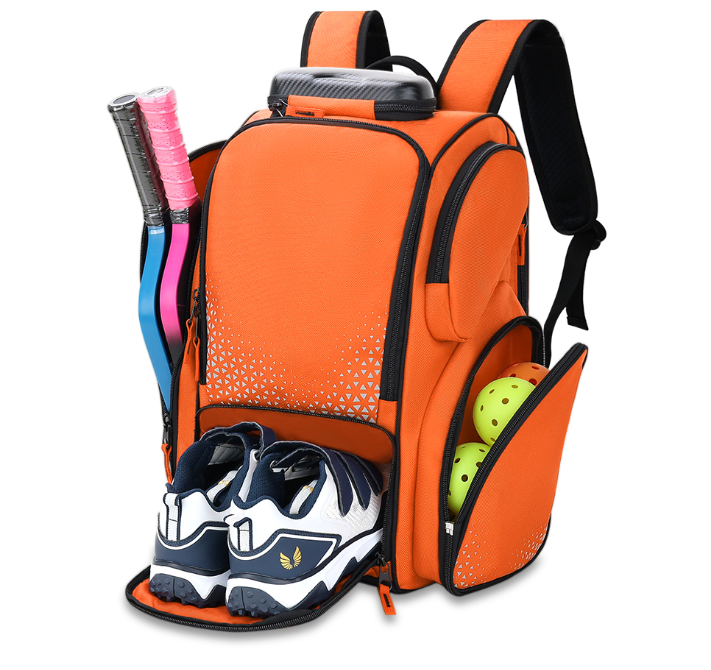
Not every fence accepts every hook. Chain-link fences have a top rail and a mesh grid, and the hook has to sit on one of them without slipping. A hook with a narrow throat grabs the top rail well. A wider hook can straddle the rail and the first mesh wire, which adds stability but may not fit every rail diameter. Before hanging, check three things: 1. The top rail should be solid and not loose in its posts. 2. The hook opening should clear the rail without forcing. 3. The hook should have a downward curve or a retaining lip so it does not slide off when the bag swings. A hook that only rests on top of the rail without a lip will walk sideways as the bag moves in the wind.
| Hook design | Rail fit | Slip resistance | Best use | Limitation |
|---|---|---|---|---|
| Open J hook | Wide range | Low without lip | Light bag, calm weather | Slides on smooth rail |
| Closed loop hook | Narrow range | High | Standard top rail | Hard to fit thick rails |
| Coated hook with lip | Medium range | Medium to high | Most chain-link fences | Coating can wear |
| Strap and clip | Flexible | Medium | Rails and mesh | Clip can scratch coating |
These are field observations from club courts, not lab ratings. Fit depends on rail diameter and hook geometry.
A fence hook is only as strong as the load path behind it. If the hook is sewn to a thin panel with a single stitch, a heavy bag will pull the stitch before the hook fails. If the hook is anchored to a reinforced patch and a webbing strap, the load spreads into the bag body. Load balance matters too. A bag hanging with all the weight on one side of the hook will rotate and press the hook against the rail at an angle. That angle increases friction and wear. Pack heavier items low and centered so the bag hangs plumb. A bag that hangs crooked is not just annoying. It puts a sideways load on the hook anchor and the fence rail.
An outdoor pickleball club in coastal Florida used a row of chain-link fences with smooth galvanized top rails. Players hung bags by open J hooks during morning sessions. Afternoon sea breezes picked up, and several bags slid along the rail and dropped onto the concrete. The hooks had no retaining lip, and the rails were slick. The club switched to hooks with a coated lip and a shorter throat. Bags stayed on the rail through the afternoon wind. The fix was not a stronger hook. It was a hook shape that matched the rail and resisted lateral walking. The lesson applies anywhere wind or vibration is present. Hook strength without slip resistance is only half the job.
A fence hook is not always the right choice. Thin mesh fences with no top rail give the hook nothing solid to grab. Wooden fences can splinter and snag fabric. Very heavy bags, especially wheeled models packed with gear, can exceed what a small hook and a lightweight rail should carry. Wind is another factor. A bag hanging like a sail catches gusts and puts repeated load on the hook and the fence. In those conditions, the ground or a bench is safer. The honest position is that the hook is a convenience feature for typical court fences and typical loads. It is not a structural anchor, and it should not be treated like one.
A fence hook that lasts depends on small construction choices: a reinforced anchor patch, a webbing strap that spreads load, a coated hook that resists rust, and stitching that does not pull at the attachment point. ASTM D6775 covers webbing breaking strength, and it is a useful reference when comparing hook straps. Buyers can check the anchor by pulling the hook firmly with the bag empty and watching for stitch movement. For supply partners, KOP is worth a closer look, with annual output above six million bags, about forty percent wheeled bags, and a standardized testing process before release. A fence hook is a small part of a pickleball bag, but it depends on the same discipline as the rest of the construction: controlled materials, consistent stitching, and a release check that catches weak anchors before the bag reaches a court.

 EN



 Hot News