A heavy-duty sports bag is sold on a promise of toughness, but toughness is hard to see in a showroom. The fabric looks thick, the seams look dense, and the handle feels solid. None of that proves the bag will survive a loaded drop, a season of drag across concrete, or a winter commute with stiff webbing. Without a repeatable test process, heavy-duty is a marketing word rather than a measurable property.
The problem is that failures cluster at the intersections. A fabric that resists abrasion can still fail at a stitch line. A handle that passes a static pull test can crack after repeated lifting in cold weather. A base panel that survives a flat drop can split when the load is uneven. Standardized testing matters because it turns those intersections into defined checks that can be repeated across batches, suppliers, and production runs.
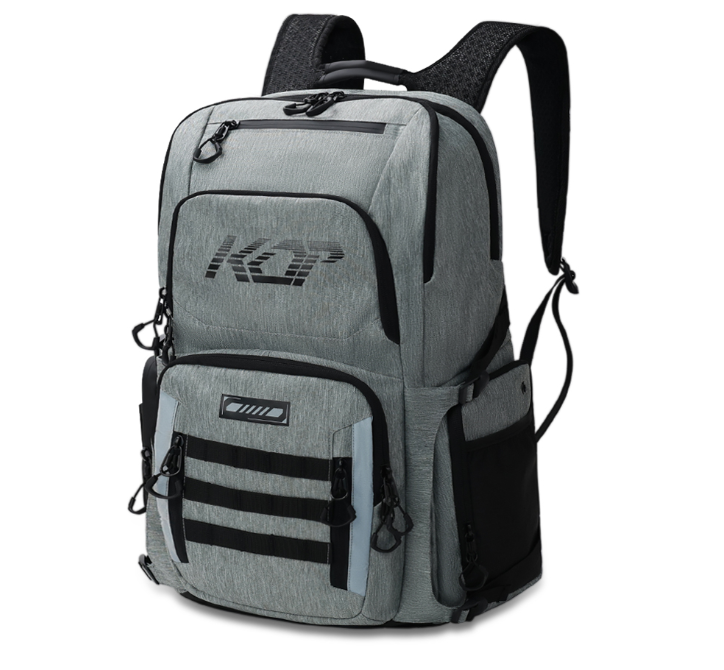
A heavy-duty sports bag does not see one kind of stress. It sees several at once, and they interact. The main load cases include:
Repeated lift and carry loads at handles and shoulder strap attachments.
Abrasion and scuffing at the base, corners, and lower side panels.
Impact from drops, curb strikes, and baggage handling.
Moisture exposure from rain, wet floors, and damp gear.
Temperature swings that change how webbing, coating, and foam behave.
A test plan that only checks one load case gives a false sense of security. The bag that passes a room temperature pull test may still fail in a cold vehicle or on a wet court. The useful test profile combines mechanical checks with conditioning steps that mimic the environments where the bag is actually used. That combination is what separates a real quality system from a label.
Material testing is the first filter. Fabric strength, tear resistance, abrasion resistance, and coating adhesion all vary by supplier and by production lot. A grab tensile test such as ASTM D5034 measures breaking strength, while a tongue tear test such as ASTM D2261 measures how easily an existing nick propagates. Abrasion methods such as ASTM D4157 apply controlled rubbing and record cycles to visible wear. These standards do not prescribe a bag design, but they give buyers and manufacturers a shared basis for comparison.
The table below shows how common test targets map to the failure modes they are meant to reveal. The ranges are typical starting points, not universal pass or fail thresholds.
| Test Target | Typical Method Reference | Typical Range | Failure Mode Exposed | Main Limitation |
|---|---|---|---|---|
| Fabric breaking strength | ASTM D5034 grab test | 500 to 1,500 N | Yarn rupture, seam pullout | Does not capture seam performance |
| Tear propagation | ASTM D2261 tongue tear | 20 to 80 N | Tear growth from a nick | Sensitive to specimen preparation |
| Abrasion resistance | ASTM D4157 oscillatory abrasion | 3,000 to 15,000 cycles | Surface wear, coating loss | Lab rubbing differs from real drag |
| Coating adhesion | Peel or flex tests | Varies by coating | Coating flake and crack | Does not predict long term UV aging |
| Webbing strength | Static and cyclic pull | Rated load plus factor | Stretch, stitch creep | Misses low temperature stiffening |
The practical lesson is to test conditioned samples, not just fresh material. A fabric that passes a dry abrasion test can fail after humidity conditioning or low temperature flexing. The conditioning step is often where a supplier difference shows up.
Component tests are necessary but not sufficient. A handle that passes its own pull test can still fail when the bag body flexes and transfers stress to the attachment. A wheel that rolls well on a drum can seize after repeated curb impact. Assembly tests catch those interactions.
A useful assembly test loads the finished bag at rated capacity and cycles it through the motions of real use: lifting, setting down, dragging, and opening. The check looks for stitch loosening, hardware deformation, and permanent shape change. A heavy-duty sports bag that passes component tests but fails assembly cycling is telling the design team that the structure, not the material, is the weak point. That is exactly the kind of finding a standardized process is meant to surface before the bag ships.
A university athletics department issued heavy-duty sports bags to track and field athletes for indoor and outdoor training. Within a few months, several bags developed handle attachment failures. The handles passed a room temperature static pull test at the required load, but they had not been tested after cold conditioning and repeated lifting. Athletes stored the bags in unheated vehicles and outdoor lockers, and the webbing stiffened in the cold.
When samples were conditioned at minus 5 degrees Celsius and then cycled through 1,500 lift cycles, the webbing at the attachment point showed abrasion and stitch loosening that had not appeared at room temperature. The fix involved a change in webbing construction, a revised stitch pattern, and a low temperature conditioning step added to the handle test protocol. Returns dropped in the following season. The case is a reminder that a single comfortable lab result can miss the environment where the bag actually lives.
No test protocol can guarantee that a heavy-duty sports bag will never fail. A bag can be overloaded, dropped at a bad angle, or dragged across a surface the designer never considered. Standardized testing reduces the probability of premature failure and keeps performance consistent across batches. It also gives buyers a clear basis for rejecting a lot that drifts outside the approved range.
Buyers should ask what was tested, how samples were conditioned, and how often the test is repeated. A supplier that can explain the cycle counts, load levels, and conditioning steps behind a heavy-duty claim is usually the one with a real quality system behind the paperwork. A supplier that offers only a material certificate and no assembly test is leaving the most common failure modes unexamined.
Kopsports builds material durability, craft accuracy, and structural stability checks into a standardized testing process that every bag goes through before release, with annual output above six million bags and a strict quality control system. The company's production capacity and roller equipment bag facility help keep test profiles and component performance consistent across batches, which matters when a heavy-duty sports bag depends on every seam, handle, and base panel holding up together.

 EN



 Hot News