A tower-style stand-up hockey bag is built around a simple promise: the bag stays upright when loaded, so gear goes in and comes out without the whole thing folding over. That promise only holds if the structure can carry the load. A regular duffel collapses into a pile and that is fine because nobody expects it to stand. A stand-up hockey bag is different. Players shove it into a locker room corner, lean it against a wall, or leave it upright in a garage between games. If the frame, base, and sidewalls cannot hold their shape under the weight of skates, pads, and helmets, the bag turns into a floppy sack with a handle. Structural stability is the feature that makes the tower format useful in the first place.
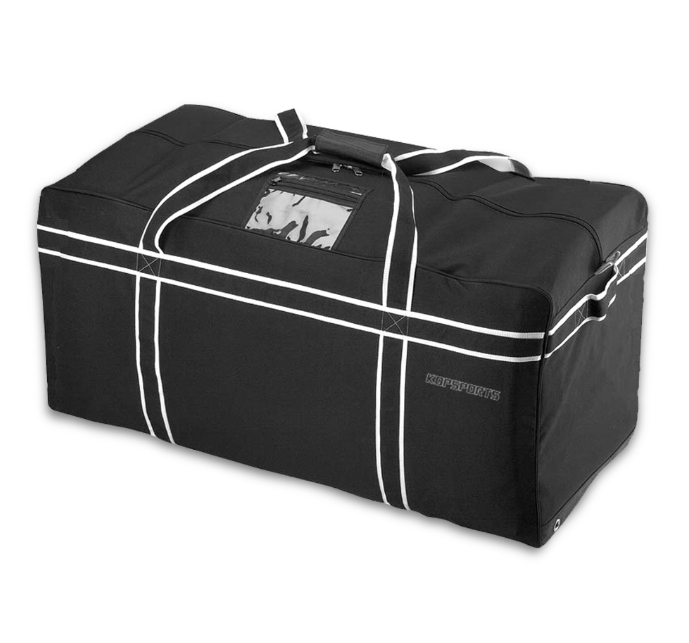
Failures on tower bags tend to show up in predictable places. The base panel sags in the middle and the bag leans. Sidewalls bow outward, which puts extra tension on the zipper. The internal frame, if there is one, bends at the joints. A loaded bag rolled over a curb can twist the base and pull the sidewall stitching. None of these problems appear when the bag is empty on a showroom floor. They appear after a season of real use, when wet gear adds weight and the bag gets dragged instead of carried. A bag that looks rigid in a photo can still collapse at the base seam if the panel and frame are not matched to the load.
| Structural area | Weak tower bag behavior | Stable tower bag behavior |
|---|---|---|
| Base panel | Sags in the center, bag leans | Holds flat, keeps the bag upright |
| Sidewalls | Bow outward under load | Stay vertical, reduce zipper tension |
| Internal frame | Bends at joints | Maintains shape through loaded rolling |
| Zipper path | Pulls open at curves | Stays aligned with sidewall support |
A stand-up bag does not stay upright because of one stiff part. It stays upright because the base, frame, and sidewalls share the load. The base carries the weight of the gear and spreads it to the corners. The frame, whether it is a wire frame, a plastic sheet, or a molded panel, keeps the sidewalls from bowing. The sidewalls tie the base to the top and keep the zipper path straight. If any part of that chain is too soft, the next part takes more stress than it was designed for. A stiff base on soft sidewalls just moves the failure to the zipper. A strong frame with a weak base lets the bag sink. Good structural design matches stiffness across the system so the load moves through it without a weak link.
A youth hockey club in the upper Midwest once ordered a run of tower bags for a travel program. The first samples looked solid on a table. Empty bags stood upright without trouble. Then the club loaded a few bags with full gear for a weekend tournament and left them upright in a warm equipment room. By the second day, the base panels had started to sag and two bags were leaning against a wall. The base material met the stated thickness, but its stiffness was lower than the sample lot. The fix was a revised base panel with a stiffer core and a reinforced bottom seam. The revised bags were tested loaded and upright for several days before approval. That case is a reminder that a tower bag can pass an empty look test and still fail the first time it carries real weight.
Soft goods testing offers recognized methods that map to structural checks on stand-up bags. ASTM D5034 covers fabric tensile strength, and ASTM D1683 covers seam strength. Those tests do not directly measure frame stiffness, but they show whether the materials holding the structure together can take the load. For tower bags, a loaded upright test over time is more direct. A bag filled with gear and left standing for a defined period should not lean or sag at the base. A loaded roll test and a handle pull test add useful data. The standard is a starting point, not a guarantee. Running the test on production lots and acting on the results is what separates a stable bag from a claim on a spec sheet.
Buyers can ask questions that separate a stable tower bag from a cosmetic one. What supports the base panel? Is there an internal frame, and how is it attached? How do the sidewalls stay vertical under load? Has a finished bag been tested loaded and upright over time? A factory that can answer with test records is safer than one that only describes fabric weight. Capacity matters, but only when it comes with controls. Kop Sports runs a production operation built around standardized testing and strict quality control before release, with experience across sports bag and wheeled bag lines. That setup does not guarantee every bag will stand perfectly forever, but it makes structural checks a routine part of the process instead of an afterthought.

 EN



 Hot News