A gym bag that gets used five days a week faces a predictable grind. It rides in a car trunk, gets shoved into a locker, sits on a damp locker room floor, and carries shoes, a towel, a water bottle, and sometimes a laptop. None of those events is dramatic on its own. Together they create a slow accumulation of abrasion, flex fatigue, and moisture exposure. Material durability matters because the failure usually shows up at the worst moment, a strap tearing on a crowded train or a zipper splitting before a workout. The real question is not whether a bag will wear. It is how long the bag stays functional before wear becomes a daily annoyance.
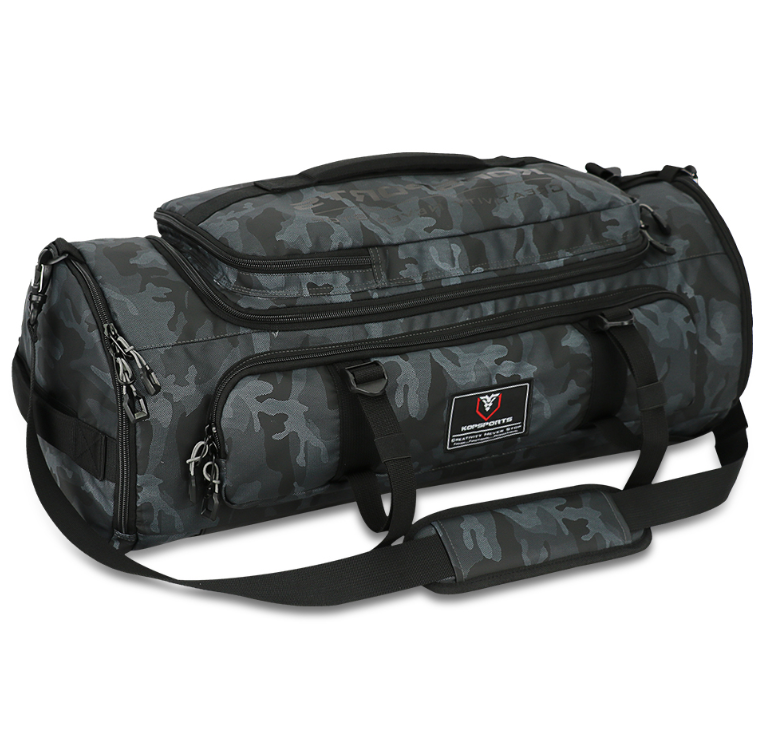
Most daily-use gym bags fail at surfaces that rub. The bottom panel drags across concrete, the side panel brushes against car seats, and the shoulder strap rubs against a jacket. Abrasion resistance is measured with tests like ASTM D4157, the Taber method, or Martindale rub testing. A 600D polyester with a polyurethane coating will usually outlast a thin 210D nylon in these tests, but the coating matters as much as the yarn. A coating that cracks after repeated flexing exposes the fabric to moisture and UV, and the abrasion rate climbs. That is why a heavier fabric is not automatically a better choice. The coating, weave, and backing have to work together.
Gym bags live in a humid microclimate. Wet towels, sweaty clothes, and damp locker room floors push moisture against the lining. A coated polyester or nylon resists water penetration, but the coating can degrade if it is exposed to repeated flexing and heat. Polyurethane coatings are flexible and resist cracking better than some PVC coatings, though PVC often costs less. The tradeoff shows up in cold weather, where a stiff coating can crack along fold lines. A bag that stays wet inside for hours also grows odor, and odor is a durability issue because it shortens the useful life of the bag even when the fabric is intact. A wipeable lining and a small vent help, but the coating quality decides how long the barrier lasts.
| Material choice | Abrasion resistance | Moisture resistance | Flex durability | Typical tradeoff |
|---|---|---|---|---|
| 600D polyester with PU coating | High | Good | Good | Slightly heavier |
| 210D nylon with PU coating | Moderate | Good | High | Lower abrasion resistance |
| 1680D ballistic nylon | Very high | Good with coating | Moderate | Higher cost and weight |
| PVC-coated polyester | High | Very high | Low in cold | Stiffens and can crack |
| Uncoated cotton canvas | Moderate | Low | High | Absorbs water and odor |
Fabric durability gets the attention, but seams and zippers often fail first. A seam carries load through thread and stitch pattern. A loose stitch density or a dull needle can cut the yarn and create a tear starter. ASTM D1683 measures seam strength, and the results often explain why a bag that looks sturdy splits at a handle anchor. Zippers face a different load. A main zipper on a gym bag opens and closes several times a day, often under tension when the bag is overpacked. ASTM D2061 covers zipper strength, and a coil zipper with a molded slider usually outlasts a thin nylon coil under repeated use. The weak point is often the seam where the zipper tape meets the bag body, not the zipper teeth.
During a locker room upgrade at a regional gym chain, the operations team tracked bag failures across 12 locations for six months. Members were using thin promotional duffels with uncoated nylon and single-stitch handle anchors. The failure pattern was consistent. Handle anchors tore first, followed by bottom panel abrasion and zipper separation. The chain switched its member bag program to a 600D polyester with a PU coating, a reinforced bottom panel, and bar-tacked handle anchors. Replacement requests dropped noticeably in the following two quarters, and the complaints shifted from torn handles to zipper stiffness on overpacked bags. The useful lesson was not that heavier fabric solves everything. It was that the failure pattern pointed to specific stress points, and the material upgrade had to target those points.
Lab tests are useful because they compress months of wear into a repeatable procedure. Abrasion tests, seam strength tests, and zipper cycling tests all produce numbers that can be compared across suppliers. The limitation is that lab tests do not perfectly reproduce real use. A bag that passes a Martindale test can still fail at a handle anchor if the stitch pattern is wrong. A coated fabric that scores well on moisture resistance can still grow odor if the lining traps damp air. Buyers should ask for test data on the specific stress points that matter, not just a single fabric score. A standardized testing process before release should cover material durability, craft accuracy, and structural stability, and the results should be traceable to the batch.
A more durable gym bag is usually heavier, stiffer, or more expensive. A 1680D ballistic nylon bottom resists abrasion well, but it adds weight and cost. A stiff PVC coating handles water, but it can crack in cold weather and feels less flexible. A bag with thick padding protects contents, but it also adds bulk and reduces usable volume. The honest answer is that durability is a balance, not a maximum. A daily-use bag needs enough abrasion resistance for the surfaces it meets, enough seam strength for the loads it carries, and enough moisture resistance for the environment it lives in. Buyers who match those requirements to the actual use pattern get a better result than buyers who chase the heaviest fabric on the spec sheet.
KOP’s production base supports that kind of material and construction planning with annual output above 6,000,000 pieces, about 40 percent wheeled bags, thousands of skilled workers, and professional roller equipment. Every bag goes through a standardized testing process under a strict quality control system before release, covering material durability, craft accuracy, and structural stability. For daily-use gym bags, the value is a durability plan built around real wear points, not a single fabric number.

 EN



 Hot News