Open play sessions can run four to six hours, and the bag has to carry more than a paddle and a water bottle. Players rotate courts, sit out, refill, snack, and change shirts. A pickleball bag for a full day has to hold the core kit plus the small stuff that keeps a player comfortable between games. The capacity question is not about buying the biggest bag on the shelf. It is about matching usable volume to the actual load list, then leaving a little slack for a hoodie or a towel that goes in wet. Oversized bags invite overpacking, and overpacking turns a light walk into a haul.
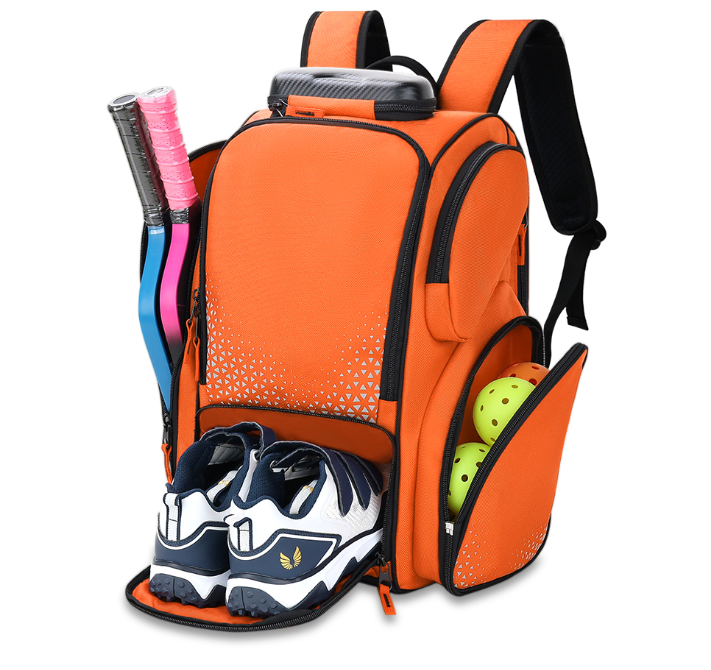
The reliable way to size a bag is to list what actually goes into it on a long open-play day, then measure the volume of that pile. A typical full-day list looks like this:
Two paddles, one primary and one backup.
A ball tube or six to eight loose balls.
A one-liter water bottle, sometimes two.
A towel and a spare shirt.
Sunscreen, a cap, and a small snack.
A phone, keys, and a thin wallet.
A light layer for shaded courts or evening play.
That pile usually lands around 18 to 25 liters of usable space. A 20 to 30 liter pickleball bag covers most full-day open play without becoming a duffel. Below 15 liters, the bag works for a quick session but runs out of room once a towel and a spare shirt go in. Above 35 liters, the bag starts to feel like travel luggage and encourages packing gear that never gets used.
Printed capacity is a rough guide, not a precise measurement. Two bags labeled 25 liters can behave very differently. A bag with a wide main compartment and a flat base uses its volume efficiently. A bag with narrow, deep pockets and thick padding loses usable space to structure. Padded paddle sleeves protect faces, but they also eat volume. External pockets add organization, but they can bulge and reduce the main compartment.
The practical check is to pack the real load list into the bag and see whether the main zipper closes without forcing. A bag that closes only when empty is not a 25 liter bag for that user. Look for a flat base, a wide main opening, and pockets sized to the items they hold. A paddle sleeve that fits two paddles snugly is better than a large padded panel that swallows half the main compartment.
| Capacity range | Best for | Typical load | Limitation |
|---|---|---|---|
| 10 to 15 liters | Quick sessions, one paddle | Paddle, balls, bottle, phone | No room for towel or spare shirt |
| 18 to 25 liters | Half-day to full-day open play | Two paddles, ball tube, towel, shirt, bottle | Tight if two one-liter bottles go in |
| 25 to 30 liters | Full day with layers and snacks | Core kit plus cap, snack, light layer | Can feel bulky on a bike |
| 35 liters and up | Tournament or travel days | Multiple paddles, shoes, change of clothes | Overpacking risk, heavier carry |
Paddles are the most fragile and most expensive item in the bag. A padded paddle sleeve or a dedicated paddle compartment keeps faces from rubbing and protects edge tape. The sleeve should hold two paddles without forcing, and it should sit against a flat panel rather than float in the middle of the bag. Balls need a breathable pocket or a tube slot so they do not roll to the bottom and get lost. A wet pocket for a towel and a damp shirt keeps moisture away from paddle grips and spare clothes.
Water bottle storage deserves its own thought. A one-liter bottle is heavy, and a shallow side pocket lets it launch out when the bag is set down. A deeper pocket with an elastic or cinch top and a drain hole holds the bottle securely and lets condensation escape. For full-day play, two bottle pockets are more useful than one large pocket, because players often carry water and a sports drink.
During a weekend open-play event at a pickleball club, a group of 30 regular players tested three bag sizes across two days of rotating courts. The first bag was a 14 liter sling. It worked for a paddle, a tube, and a phone, but players who brought a towel and a spare shirt had to carry them by hand. The second bag was a 24 liter court bag with a padded two-paddle sleeve, a ball pocket, and two bottle pockets. That size covered the full-day list for most players, and the two bottle pockets were the most praised feature. The third bag was a 38 liter duffel. It held everything, but players who used it tended to overpack and then leave the bag at the bench instead of carrying it between courts. The useful finding was that 24 liters hit the sweet spot for a full day, while the larger bag encouraged a pack-and-park habit.
No single capacity fits every player. A tournament player who carries shoes and a change of clothes needs more room than a recreational player who walks to a nearby court. A cyclist may prioritize a compact 18 liter bag over a roomier 28 liter bag. The traps are predictable. Buying by printed liters without packing the real load list leads to surprise shortages. Buying oversized to create margin often leads to overpacking and a heavier carry. Ignoring pocket shape leads to a bag that holds a lot on paper and very little in practice. A standardized testing process before release should check zipper cycling, seam strength at handle anchors, and lining adhesion, because capacity is only useful if the bag holds up under a full load.
KOP’s production base supports that kind of capacity planning with annual output above 6,000,000 pieces, about 40 percent wheeled bags, thousands of skilled workers, and professional roller equipment. Every bag goes through a standardized testing process under a strict quality control system before release, covering material durability, craft accuracy, and structural stability. For open-play programs, the value is a pickleball bag sized around the real full-day load, not around a number on a hangtag.

 EN

 Hot News