A baseball bag rarely dies from a broken zipper or a torn strap. The bottom goes first. Think about the daily routine: the bag gets dropped on concrete dugout floors, dragged across gravel parking lots, stacked in a equipment shed, and loaded with helmets, cleats, and sometimes a dozen bats. The bottom panel takes the brunt of every one of those contacts. Once the outer fabric abrades through, moisture sneaks into the padding, and the whole structure starts to soften. A small scuff becomes a tear, then a hole, and soon the bag is shedding foam or letting dirt into the main compartment. A reinforced bottom panel changes that failure timeline. It does not make the bag indestructible. It buys enough extra wear resistance to keep the bottom intact through a full season of real use, which is often the difference between replacing a bag every few months and getting multiple seasons out of it.
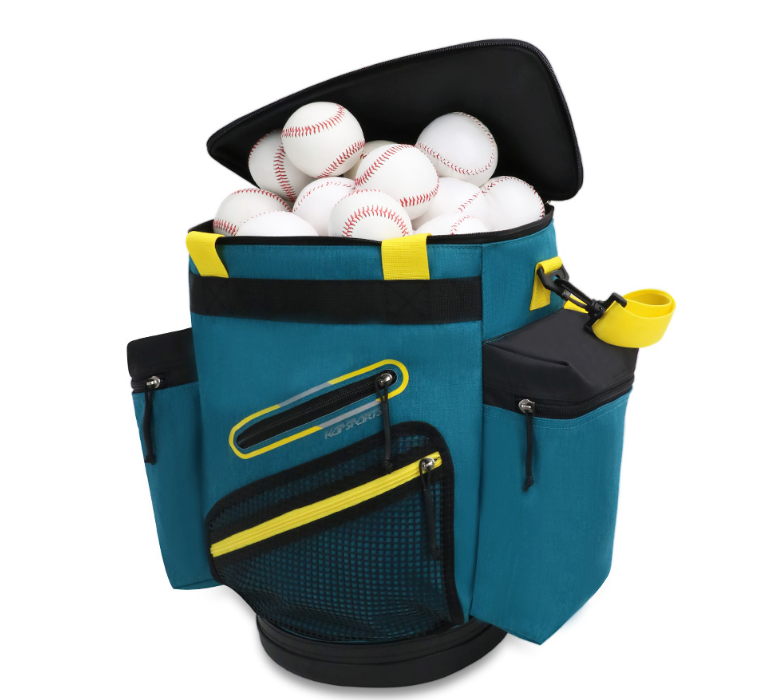
A reinforced bottom panel is not just a second layer of fabric glued on. Good construction uses a higher-denier abrasion-resistant material, often a 600D to 1000D polyester or nylon with a polyurethane coating, bonded or stitched over the base panel. The key is how the load transfers. When the bag sits on a rough surface, the bottom panel experiences compression, shear, and abrasion at the same time. A single-layer bottom concentrates stress at the corners and along the seam lines. A reinforced panel spreads that stress across a larger area and adds a sacrificial wear layer. The stitching pattern matters too. Bar-tack reinforcement at stress points and a bound edge that wraps around the bottom seam prevent the classic peel failure where the bottom separates from the sidewall. A reinforced bottom also stiffens the base, which keeps the bag from sagging and reduces the chance of the contents pressing directly against the ground.
A NCAA Division II baseball program in the Pacific Northwest went through a batch of standard equipment bags in a particularly wet spring. The bags were used daily for practice and travel, often set down on wet turf and concrete. Within about ten weeks, several bags showed bottom fabric wear through at the corners, and two had visible holes where the padding was exposed. The team switched to bags with a reinforced bottom panel made from a 900D coated polyester with double-stitched perimeter seams. Those bags finished the remaining twelve weeks of the season, plus fall practice, without a single bottom failure. The reinforced bags did gain a little weight, roughly 120 grams per bag, and the bottom felt stiffer when empty. For a team hauling gear every day, that tradeoff was acceptable. The case is not a controlled lab test, but it matches what most equipment managers already suspect: the bottom is where abuse concentrates.
Not every reinforced bottom performs the same. A thin vinyl patch glued to a nylon bottom might look tough in a showroom, but it often delaminates after repeated flexing. A better approach uses a woven fabric with a tight weave and a coating that resists water absorption. Coated polyester tends to handle abrasion well and stays dimensionally stable when wet. Coated nylon is lighter and stronger by weight, but it can stretch more under load. The honest limitation is that no bottom panel can survive constant dragging over sharp edges or being used as a skateboard. Reinforcement extends life under normal team use, not under deliberate abuse. Another limit is repairability. A heavily reinforced bottom can be harder to patch cleanly because the added layers complicate stitching. That is a fair trade for most programs, but it is worth knowing before choosing a bag.
Abrasion resistance can be compared using standard methods. ASTM D4157, the Wyzenbeek test, measures how many cycles a fabric withstands before visible wear. ASTM D5034 covers grab tensile strength, which indicates how much pulling force a seam or panel can take. The table below uses representative values from material supplier data sheets for common bottom constructions. These are not padel-specific or baseball-specific tests, but they give a useful comparison for bag builders and buyers.
| Bottom construction | Abrasion cycles (ASTM D4157, approximate) | Water absorption after 24 hours | Stiffness change after load | Common field result |
|---|---|---|---|---|
| Single-layer 600D polyester | 8,000 | 4.5% | High sag | Corner wear in 8 to 12 weeks |
| 600D with glued vinyl patch | 12,000 | 3.8% | Moderate sag | Patch peeling after 10 weeks |
| 900D coated polyester, double-stitched | 22,000 | 1.9% | Low sag | Bottom intact through a full season |
| 1000D nylon with TPU coating | 26,000 | 1.5% | Low sag | Strong but slightly heavier |
A reinforced bottom only delivers its promise when the production line treats it as a structural part, not an afterthought. Stitch density, seam sealing, and material lot consistency all affect how the bottom holds up. KOP runs high-volume bag production with an annual output of more than 6,000,000 pieces, including a large share of wheeled bags, and every unit goes through a standardized testing process before release. Material durability, craft accuracy, and structural stability are checked under a strict quality control system. For a baseball bag, that discipline shows up in details like consistent bar-tack placement at the bottom corners, a bound edge that does not pucker, and a reinforced panel that stays flat after repeated loading. The result is not a bag that never wears out. It is a bag that wears out much later, and usually in a less critical spot.

 EN



 Hot News