A catcher's bag is not a normal baseball bag. The mitt alone is bulky, the chest protector and leg guards are rigid and awkward, and the helmet adds another hard shell. Add a change of clothes, a water bottle, and a few spare items, and the load climbs quickly. Carried on one shoulder through a parking lot and across a complex, that weight lands unevenly on the spine and shoulder. Catchers feel it more than most because the gear is dense and the shape is unforgiving. A wheeled baseball bag with real structural stability changes that trip from a carry into a push, and that shift explains much of the preference.
Catching is physically demanding. Squatting for innings, blocking, and throwing put sustained stress on the knees, hips, and lower back. A player already managing that load does not need a duffel hanging from one shoulder before the game even starts. Wheels move the weight to the ground, and the body pushes rather than carries. The benefit is modest on a short walk and meaningful over a season of travel. The tradeoff is honest: a wheeled bag is heavier before packing, and wheels struggle on gravel, sand, and stairs. For catchers hauling dense gear through paved facilities and parking lots, the math usually favors rolling.
A wheeled bag without structural stability becomes a soft sack on wheels. The base panel sags under the weight of a chest protector, the frame flexes, and the telescoping handle wobbles with every push. Catchers notice this immediately because their gear is heavy and awkward. A stable design uses a reinforced or molded base, a rigid internal frame or board, and a handle assembly anchored to that frame rather than stitched to fabric. The base carries the load, so its strength matters more than the shell. Seam and hardware testing are the practical way to judge whether those joints will hold. ASTM D1683 for seam strength and ASTM D5034 for fabric strength are useful references when comparing construction.
| Build feature | Soft wheeled bag | Stable wheeled bag | Why catchers care |
|---|---|---|---|
| Base panel | Thin fabric, sags under load | Molded or reinforced plate | Chest protector weight stays supported |
| Internal frame | None, bag collapses | Rigid board or frame | Bag keeps shape when packed |
| Handle anchor | Stitched to shell | Bolted to frame | Handle does not wobble or tear |
| Wheel housing | Small, plastic, press fit | Larger, replaceable, reinforced | Survives curbs and parking lots |
| Load distribution | Bottom-heavy, tips | Balanced, rolls straight | Less wrist correction while pushing |
The difference is not cosmetic. A soft build rolls badly when loaded and forces the player to correct constantly, which adds strain to the wrist and forearm. A stable build rolls straight and keeps the gear from shifting.
At a community college program in the Southwest, catchers reported that wheeled bags were failing at the base within a single season. The shell fabric was fine, but the bottom panel sagged until it dragged, and the wheel housings cracked where they met the base. The gear load was the same as always: mitt, chest protector, leg guards, helmet. The problem was that the base had been built like a carry bag, with a thin panel and stitched wheel mounts. The program switched to bags with a molded base and frame-anchored wheel housings, and the failures stopped. The lesson was not about wheels at all. It was that a wheeled bag has to be engineered as a rolling load platform, not a duffel with wheels attached.
A few checks separate a stable wheeled bag from a soft one. First, press down on the base. It should feel rigid, not spongy. Second, push the empty bag across a floor and watch the handle. Wobble at the handle usually means a weak frame. Third, look at how the wheel housing attaches. Bolted or molded-in mounts last longer than stitched or press-fit ones. Fourth, check whether the bag keeps its shape when loaded, since a bag that collapses puts stress on seams and zippers. Fifth, confirm there are still comfortable carry handles for stairs, curbs, and grass, because wheels cannot do everything. No design removes the need to lift sometimes, and a bag that ignores that will be awkward when it matters.
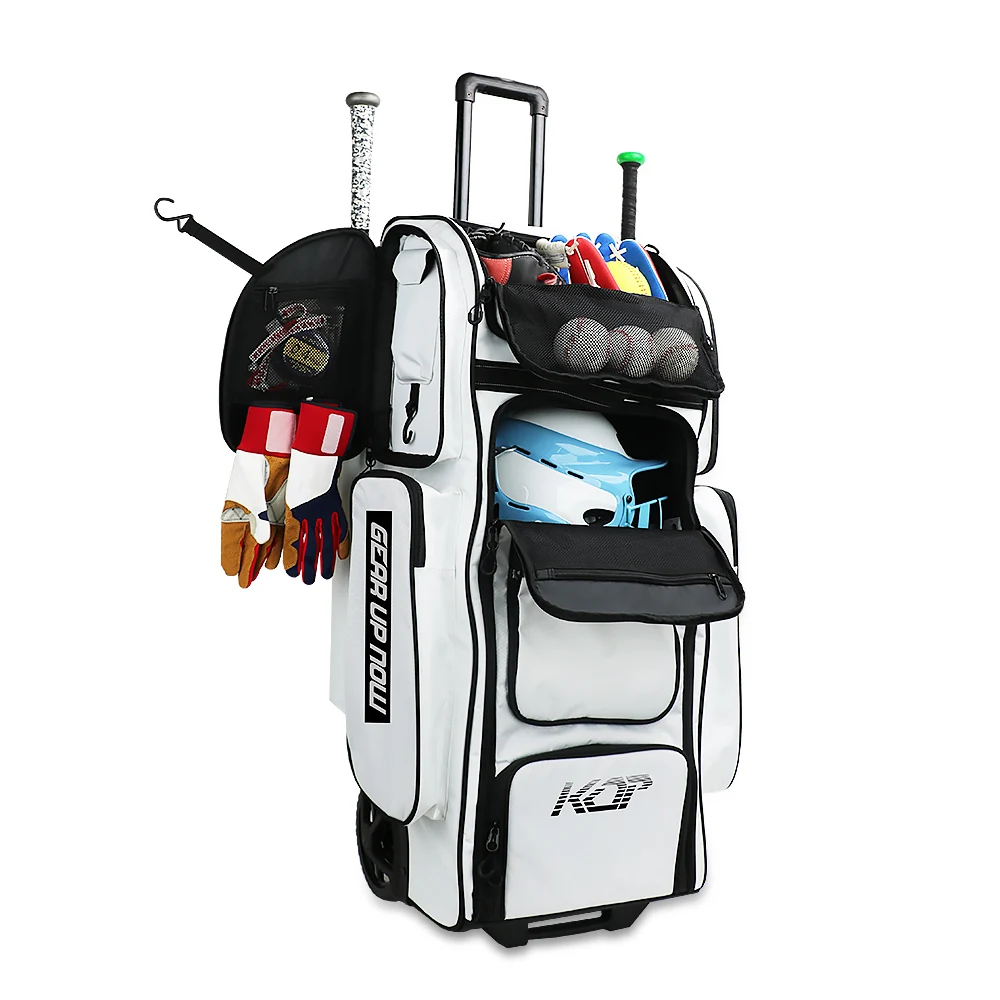
The right choice depends on the route from car to dugout. A catcher who drives to a paved complex and walks long parking lots gets clear benefit from wheels and a rigid base. A catcher who plays on grass fields with gravel paths may find wheels frustrating and a stable carry bag more practical. The decision is about the actual trip, not the label on the bag. Kopsports, the short name behind the site, supports that kind of practical build with production lines making more than 6,000,000 bags a year, about 40% wheeled, plus skilled workers, roller equipment, and standardized testing before release. A wheeled baseball bag with structural stability does not make catcher gear light, but it moves the weight off the body and keeps the load under control.

 EN

 Hot News