A clay infield is not a clean surface. It is a mix of fine grit, moisture, and abrasive dust that gets into every corner of a softball bag. The bag gets dropped on the dugout floor, dragged across the warning track, and stuffed into a car trunk while still covered in field dirt. That environment punishes seams, zipper tape, and bottom panels far more than a gym floor ever will. Material durability is critical because the failure usually starts small. A stitch line opens at the bottom corner. A coating cracks near a wheel housing. A zipper tape frays after repeated contact with grit. Once that happens, the bag stops protecting the gear inside. A softball bag for clay and dirt infields needs a shell and seam recipe that can take abrasion and repeated flex together, not just a fabric with a tough sounding name.
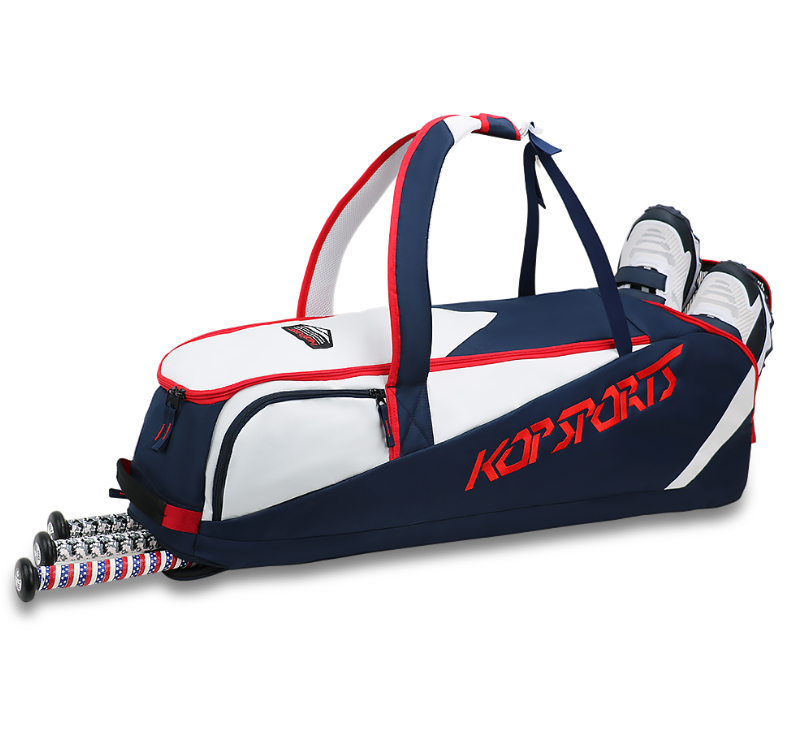
Abrasion and moisture are often treated as one problem. They are not. Abrasion is surface loss from rubbing against clay, concrete, and bench edges. Moisture is absorption and wicking from wet ground, damp towels, and rain. A bottom panel needs abrasion resistance and a barrier that does not soak through. A main shell needs tear strength and a coating that does not crack when the bag flexes. A zipper needs tape that resists grit and a slider that keeps moving after dust gets in. The table below compares common material choices against those two threats. The ranges are representative, not a single pass or fail rule.
| Material choice | Abrasion behavior in clay and dirt | Moisture behavior | Flex after drying | Common role |
|---|---|---|---|---|
| 600D polyester | Moderate, surface fuzzes over time | Absorbs slowly, dries okay | Good | Light training bags |
| 1000D nylon | High, resists grit well | Low absorption, needs coating for wet gear | Good | Main shell, bat sleeves |
| 1680D ballistic nylon | Very high, handles rough concrete | Low absorption, stiff when heavy | Moderate | Bottom panels, wheel areas |
| PVC-coated polyester | High, easy to wipe clean | Strong barrier, traps less dirt | Moderate, coating can crack | Wet fields, easy clean shells |
A heavier fabric is not automatically a better softball bag. Weight tells part of the story, but seam construction and coating adhesion decide whether the bag survives a season of clay and dirt. A 1000D nylon shell with the wrong needle size can fail at the seam before a 600D polyester bag with a proper stitch recipe. A coated fabric with weak adhesion can crack at a flex point even when the base fabric is strong. That is why material testing has to include the seam, not just the roll. ASTM D5034 covers grab tensile strength, ASTM D2261 covers tongue tear, and ASTM D4157 covers oscillatory abrasion. Those standards create a baseline. They do not replace a loaded drop test or a rolling test across rough ground. The useful question is whether the test path matches the load path the bag will actually see.
At a bag plant in southern China, a run of wheeled softball bags moved its bottom panel to a heavier nylon for better abrasion resistance. The first samples passed a flat-table abrasion check. After a loaded rolling test across a rough clay and gravel yard, the coating on two bottom panels began to crack near the wheel housing. The nylon itself was not worn through. The coating had failed under repeated flex and grit. The line changed the coating adhesion recipe and added a small reinforcement patch at the housing contact point. Abrasion performance improved without a big weight increase. That case is a blunt reminder. A material data sheet can look strong while the actual bag fails at a flex point. Testing has to follow the grit.
A useful test flow for a clay and dirt infield bag has three layers. First, incoming fabric and hardware get checked against agreed specifications. Second, in-process checks catch seam slip, needle cutting, zipper alignment, and wheel housing fit. Third, finished bag checks cover loaded drop, handle pull, zipper cycling, and a visual audit. Before release, every single bag should go through a standardized testing process paired with a strict quality control system. That system needs uniform, predefined assessments for material durability, craft accuracy, and structural stability. The quality system oversees the whole procedure so one shift does not test differently from another. Honest limits matter. No test program can simulate every dugout floor, parking lot, and trunk. A softball bag can be built to resist common clay and dirt failure modes, but it is not indestructible. The goal is a build where shell fabric, seam, coating, and hardware are tested against the same grit and flex the bag will meet on the field.
The right durability level depends on how the bag is used. A weekend player who carries a bag from car to dugout may not need a 1680D bottom panel. A travel team that rolls a wheeled bag across gravel and wet clay needs tougher corners, better wheel protection, and a coating that handles flex. Overbuilding adds weight and stiffness without solving every failure. The practical approach is mixed construction. Use a tough main shell, reinforce the bottom and wheel areas, and choose a coating that matches the moisture exposure. Kopsports runs a sports bag production line with thousands of skilled workers, annual output above six million pieces, and roughly forty percent wheeled bags. That scale supports standardized material testing and tight control over seam and coating construction. For buyers comparing softball bags for clay and dirt infields, the real advantage is not one fabric name. It is a repeatable test flow that catches seam slip, coating cracks, and abrasion drift before the bags reach the field.

 EN




 Hot News