An evening commute puts a sports backpack in a tough spot. The wearer is often walking near traffic, crossing driveways, or standing at a bus stop while drivers scan for movement. Dark clothing and a dark pack blend into the background. Reflective strips change that equation because they return light back toward the driver's eyes. The bag does not need to be bright in daylight. It needs to become conspicuous when headlights sweep across it. That is the core safety benefit: the pack stops being a dark shape and starts acting like a moving marker.
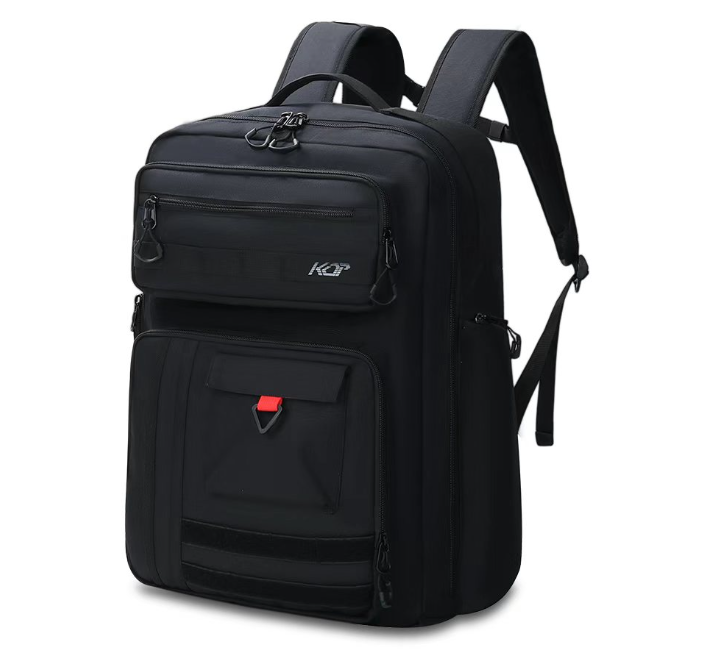
Retroreflective material is not the same as shiny fabric. A mirror reflects light at an equal angle. A retroreflective strip sends light back toward the source, which is why a driver sees a bright flash from a low-beam headlight. Glass bead and microprismatic constructions are common. Glass bead material is flexible and cost-effective, while microprismatic film often returns more light at longer distances. The catch is angle. Retroreflection falls off when the strip is viewed from a sharp side angle or when the material is bent around a curve. That is why a strip on the front of a shoulder strap can disappear when the wearer turns. Placement and surface flatness matter as much as the material itself.
A reflective strip that faces the wearer's back pocket is wasted. Effective placement follows the moving silhouette. The highest-value zones are the shoulder straps, the lower back panel, and the side panels near the hips. Those areas face traffic from the front, rear, and side. A strip across the top of the pack helps when the wearer bends forward. A hanging loop or a small tab on the side can add side visibility without much bulk. The tradeoff is comfort and wear. Strips sewn through heavy webbing can stiffen the strap. Strips on high-abrasion corners can peel or scratch. The goal is not to cover the bag in tape. It is to put reflective zones where a driver's headlights will actually hit them.
| Reflective placement | Visibility benefit | Common drawback | Practical note |
|---|---|---|---|
| Shoulder straps, front-facing | Strong front and side pickup | Can stiffen under webbing | Use flexible bead film, not rigid prismatic sheet |
| Lower back panel | Strong rear visibility | Hidden by long jackets | Keep strip wide enough to clear hem |
| Side hip panels | Good crossing visibility | Can rub against arms | Place below elbow swing |
| Top grab handle | Useful when bending | Small surface area | Pair with rear panel, not alone |
| Zipper pulls and tabs | Low-cost accent | Easy to overlook | Best as supplement, not primary |
Buyers often ask whether a strip is certified. EN ISO 20471 and ANSI/ISEA 107 are the two reference points most buyers encounter for high-visibility clothing. Those standards define retroreflective performance classes, minimum areas, and test methods. A backpack is not automatically covered by a garment standard, so a supplier may test the strip material rather than the finished pack. That distinction matters. A certified strip can still perform poorly if it is sewn at a bad angle or partly covered by a flap. The standard is a starting point, not a pass for the whole design. Buyers should ask for material test data and a placement drawing, not just a logo on a hangtag.
During a night-shift commuter pilot at a logistics campus in the Southeast, the safety team tested three backpack layouts with 60 workers who walked to and from parking areas after dark. The first layout had a single reflective strip across the top of the pack. Drivers reported seeing the strip late because it sat above the wearer's shoulder line and disappeared when the worker leaned forward. The second layout moved strips to the shoulder straps and lower back panel. Driver recognition distance improved, but side crossings were still weak. The third layout added small side tabs at hip level and a reflective loop on the top handle. The safety team measured recognition distances during controlled vehicle passes, and the side tabs closed the gap at intersections. The useful lesson was not that more reflective material is always better. It was that reflective zones have to follow the wearer's movement and the driver's line of sight.
Reflective strips are a passive safety feature. They depend on a light source, usually vehicle headlights, and they lose effectiveness when dirty, wet, or viewed from a poor angle. They do not replace active lighting, bright clothing, or safe road behavior. They also add cost and production complexity. Each strip needs a clean bonding or stitching path, and a poorly sealed edge can lift after washing. On a sports backpack, the best results come from a small number of well-placed strips that follow the silhouette, use flexible retroreflective film, and survive abrasion testing. A bag covered in strips can look busy, add weight, and still miss the key angles. Honest design means choosing placement over quantity.
KOP’s production base supports that kind of reflective placement work with annual output above 6,000,000 pieces, about 40 percent wheeled bags, thousands of skilled workers, and professional roller equipment. Every bag goes through a standardized testing process under a strict quality control system before release, covering material durability, craft accuracy, and structural stability. For evening sports backpack programs, the real value is a reflective layout that is tested on the bag, not just specified on a data sheet.

 EN



 Hot News