A baseball bag often fails in ways that have little to do with how it looks in a store. The real enemy is a dugout bench, a concrete parking lot, a trunk packed with helmets, and a player dragging the bag by one strap. A baseball bag that survives a season usually shares one trait: its materials were tested against repeatable abuse before production, not after complaints. Standardized material testing is the difference between a bag that looks durable and one that keeps its bottom seam, zipper tape, and webbing intact through daily handling.
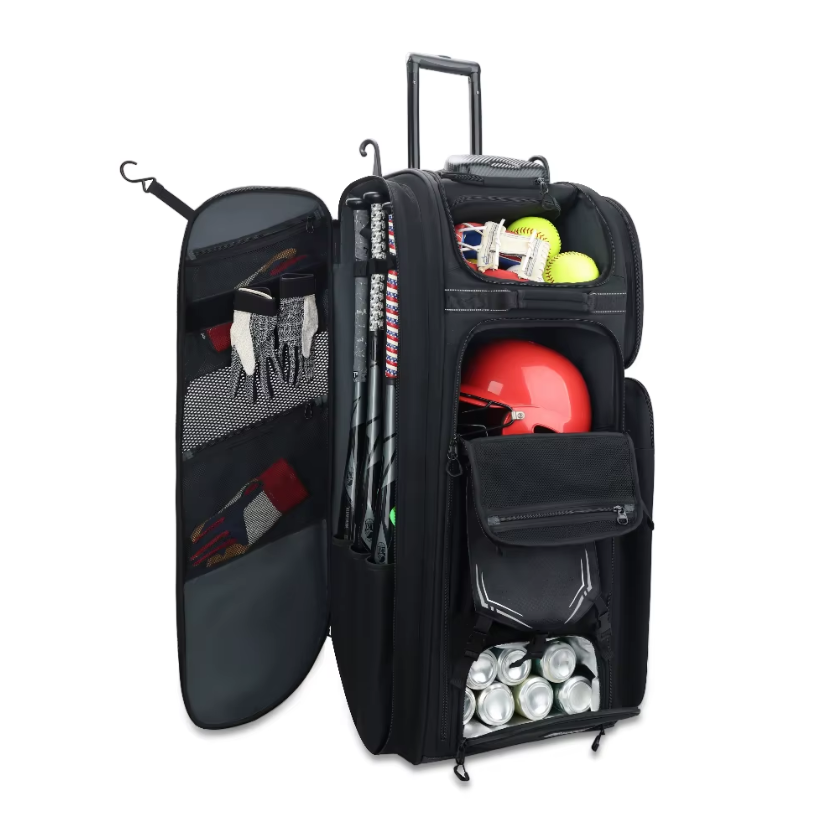
Fabric weight alone tells a small part of the story. A 600D polyester shell can outperform a heavier but poorly coated fabric if the coating adheres well and the weave resists abrasion. Standardized testing breaks performance into separate checks: tensile strength, tear resistance, abrasion cycles, seam strength, and zipper reciprocation. Each check uses a fixed procedure so results can be compared across suppliers and production lots. The table below shows a practical test map for a baseball bag.
| Test area | Common reference | What it reveals | Why it matters on a baseball bag |
|---|---|---|---|
| Fabric tensile strength | ASTM D5034 | Breaking force of woven shell | Resists stretching when the bag is overloaded |
| Tear resistance | ASTM D2261 | Force to propagate a tear | Stops small cuts from becoming long splits |
| Abrasion resistance | ASTM D4157 | Cycles before visible wear | Matters at the bottom panel and drag points |
| Seam strength | ASTM D1683 | Load a stitched seam holds | Protects handle and strap attachments |
| Zipper durability | ASTM D2061 | Reciprocating cycle performance | Exposes weak sliders and tape |
No single number proves a bag is tough. A high tensile shell with weak seam construction still fails at the handle. A strong zipper on a thin tape can pull out under load. Standardized testing works when results are read together, and when the same test plan is applied to every production lot.
Lab data only matters if it predicts field behavior. In one review of youth baseball gear, a training center in a humid southern region reported bottom seam failures after bags were dragged across concrete walkways. The shell fabric passed a basic tensile check, but the bottom panel showed heavy abrasion and the seam used a stitch density below the specification. Once the specification added an abrasion cycle target for the bottom panel and a minimum stitch density for load-bearing seams, the failure pattern changed. That case is not unusual. Rough handling rarely attacks the whole bag evenly. It concentrates on the bottom, the handle, the strap junction, and the zipper curve.
Testing tends to expose the same weak points across bag designs. The bottom panel takes the most abrasion when a bag is set down or dragged. Handle and shoulder strap attachments carry the highest concentrated load, especially when one strap is used to pull a loaded bag. Zipper curves at the main opening see repeated stress, and a slider that feels smooth in a showroom can skip teeth after months of grit. Interior lining also matters, since a rough liner can abrade helmet padding or glove leather. A test plan that ignores these zones can pass a bag that still fails in the first month of practice.
Test reports can look intimidating, but a few habits make them useful. First, check that the report identifies the exact material and production lot, not just a generic fabric name. Second, compare test methods, since a tear test and a tensile test answer different questions. Third, look for pass or fail limits tied to the intended use, not just raw numbers. A bag sold for daily team use needs different limits than a light weekend bag. Fourth, ask whether the same test plan is repeated during production, because a single passing sample says little about consistency. These checks are basic, but they separate a real quality system from a folder of certificates.
A purchasing decision becomes more reliable when test evidence is tied to production, not only to a sample room. A supplier that runs standardized material testing before release, with the same procedures applied across lots, gives buyers a way to compare bags on facts rather than feel. That approach also helps explain cost differences. A coated shell, reinforced bottom, and tested seam construction cost more than a basic build, and the test record shows where that money goes. Kopsports, the short name behind the site, supports this kind of sourcing with production capacity above 6,000,000 bags a year, about 40% wheeled, plus skilled workers, roller equipment, and a standardized testing process before each bag is released. Standardized material testing does not make a baseball bag indestructible, but it makes rough handling a known risk instead of a surprise.

 EN

 Hot News