A defensive pole in lacrosse is not just a longer version of a short stick. It changes the load profile of a lacrosse bag. A typical defensive shaft runs about 52 to 72 inches depending on the level of play, and the head adds a few more inches of offset. That length creates leverage. When a pole sits loose inside a bag, every turn, brake, and curb drop sends a bending moment into the shaft, the head, and the bag hardware. A heavy-duty lacrosse bag can carry the weight, but weight is not the only issue. The real risks are shifting, end impact, and zipper strain. A pole that slides during transport can crack a head, tear a liner, or push a zipper open from the inside. Securing a long pole safely means controlling both position and motion, not just getting the bag closed.
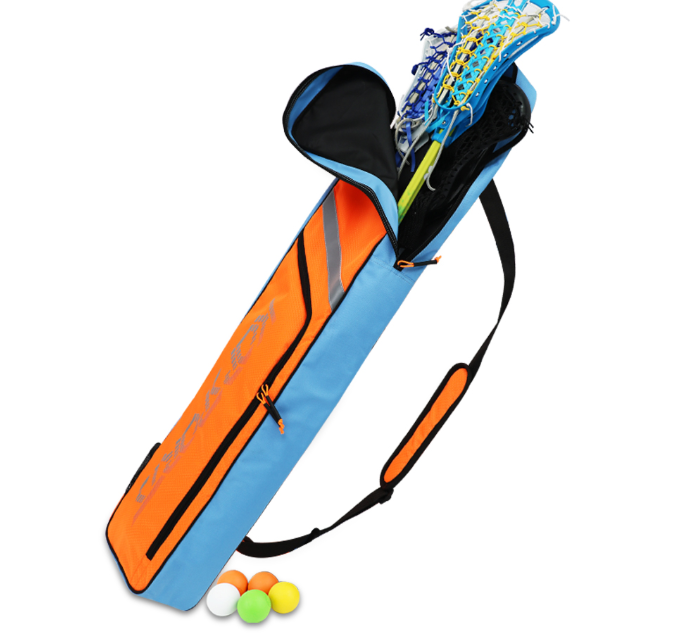
Many heavy-duty lacrosse bags include an external stick sleeve or a side stick pocket. That sleeve exists for a reason. It keeps long shafts outside the main load zone, where helmets, pads, and cleats press against the bag walls. A pole placed in the main compartment adds internal pressure to the zipper line and can trap moisture against the shaft. The external sleeve also makes the pole easier to remove without unpacking the whole bag. The catch is that not every sleeve is long enough for a defensive pole. A sleeve designed for a short stick may leave the head or the butt end exposed. In that case, the sleeve can still be used as a primary holder, but the exposed end needs a secondary tie or a padded cap. Checking sleeve depth before loading is a small step that prevents a lot of damage.
Straps are the difference between a pole that stays put and a pole that acts like a battering ram inside the bag. Two straps are better than one, and they should sit at different points along the shaft. A common mistake is cinching one strap near the middle and calling it done. A single strap allows the ends to pivot. A better setup uses one strap just below the head and one near the butt end, with both pulled snug but not crushed. The strap material matters too. Flat webbing distributes pressure better than a thin cord, which can dig into the shaft finish. Buckles should be metal or heavy-duty acetal, not thin plastic that cracks in cold weather. A simple pull test before a trip, tugging the pole sideways by hand, shows whether the straps actually hold or just look tight.
The ends of a defensive pole take the worst hits. The head is the most fragile part, and the butt end is the hardest point of contact. A padded head cover or a neoprene sleeve around the head reduces impact damage and keeps strings from snagging on bag hardware. On the butt end, a rubber cap or a foam wrap protects both the shaft and the bag liner. These small additions also reduce noise and prevent the pole from marking other gear. The tradeoff is bulk. A thick head cover can make the sleeve tighter, and a foam cap can add a few millimeters that change how the pole sits. That is a fair trade for anyone who has seen a cracked head after a rough ride. The key is to pad the ends without blocking the strap contact points.
A long pole changes the center of gravity of a lacrosse bag. If the pole sits on one side, a wheeled bag may pull to that side, and a shoulder carry may dig into one shoulder. The fix is simple but often ignored. Place the pole on the side opposite the heaviest internal load, or split the internal weight so the bag stays balanced. For wheeled bags, check that the pole does not extend past the wheelbase in a way that catches on curbs. For duffel-style carries, adjust the shoulder strap so the pole side sits slightly higher. A balanced bag is easier to control, and a controlled bag puts less stress on straps, seams, and the pole itself. Balance is not a cosmetic detail. It is part of safe transport.
Different securing methods produce different results under transport stress. The table below uses representative field observations from team travel and club use, not a certified lab report. The figures are approximate and vary with bag design, pole length, and road conditions. The testing logic follows the same principle as ASTM D5034 for fabric and seam tensile strength and ASTM D2061 for zipper strength, applied here to real loading outcomes.
| Securing method | Shaft movement during transport | Zipper strain risk | Head damage risk | Best use case |
|---|---|---|---|---|
| Loose in main compartment | High | High | High | Short local trips only |
| External sleeve, no straps | Moderate | Low | Moderate | Calm transport, short distances |
| External sleeve plus two straps | Low | Low | Low | Daily team travel and bus rides |
| Sleeve plus straps plus padded ends | Very low | Very low | Very low | Long road trips and tournament travel |
The pattern is clear. Adding straps and end protection reduces movement and strain, but it also adds setup time. No method eliminates risk entirely. A pole can still be damaged in a serious accident or by deliberate misuse. The goal is to reduce the everyday failure modes that show up on buses, in parking lots, and at tournament gates.
Securing a long pole safely depends on both the method and the bag. A sleeve that tears at the seam or a strap that pulls out of its anchor will fail no matter how carefully the pole is loaded. Stitch density, webbing anchor strength, and zipper gauge set the real limits. KOP runs high-volume bag production with an annual output of more than 6,000,000 pieces, including a large share of wheeled bags, and every unit goes through a standardized testing process before release. Material durability, craft accuracy, and structural stability are checked under a strict quality control system. For a heavy-duty lacrosse bag, that discipline shows up in reinforced sleeve seams, strap anchors that hold under repeated pull, and zippers that resist internal pressure. The result is not a bag that makes transport risk disappear. It is a bag that gives a long defensive pole a fair chance on the road.

 EN




 Hot News