A fence hook looks like the simplest piece of hardware on a dugout baseball bag, which is exactly why it gets misused. Players clip the bag onto chain link at eye level, load it with bats and helmets, and walk away. Two innings later the bag has slid down the fence, the hook has bent, or the whole thing has dropped onto a concrete dugout floor. The hook itself is rarely the weak point. The problem is how the load is distributed and what kind of fence the hook is grabbing. Understanding those two things turns a dangling accessory into a genuinely useful feature.
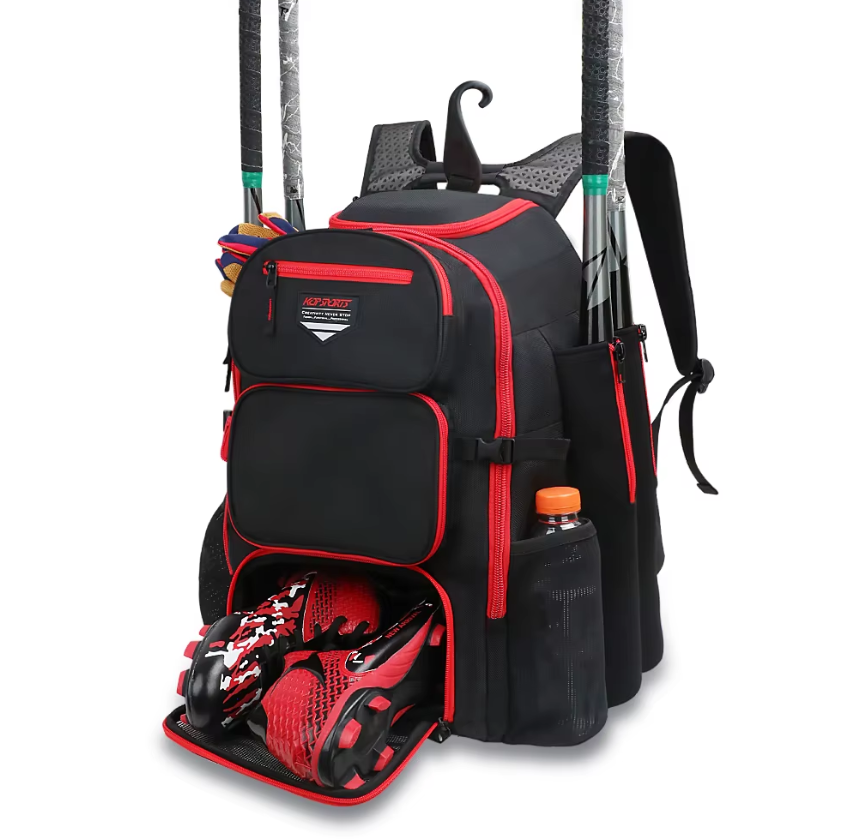
Not every fence takes the same hook. Chain link with a standard two inch mesh is the most common dugout surface, and a J shaped hook or a double prong hook sits well in the mesh without much play. Vinyl coated chain link, common at youth complexes, is thicker, so a narrow hook can bind or scrape the coating. Solid bar fencing and temporary outfield fencing need a different approach entirely, often a strap loop rather than a rigid hook. A hook that fits loosely in the mesh will swing and slap the fence in wind, which wears the coating and annoys everyone in the dugout. A hook that fits too tightly is hard to remove between innings.
The most common mistake is hanging the bag at shoulder height with all the weight at the bottom. That creates a lever arm against the hook and the fence mesh. A better approach is to hang the bag lower, near knee to hip height, so the load sits closer to the fence's strongest point. Distribute weight evenly across the bag's width, and keep heavy items like bats and water bottles near the center rather than in one outer pocket. A bag that hangs crooked pulls on one hook and can pop it loose. The table below shows how hang height and load placement affect hook performance.
| Hang height | Load placement | Hook stress | Practical result |
|---|---|---|---|
| Shoulder height | Heavy items at bottom | High, lever effect | Hook bends, bag slides |
| Hip height | Weight centered | Moderate | Stable through a game |
| Knee height | Weight centered | Low | Very stable, harder to reach |
| Any height | All weight in one pocket | Uneven, twisting | One hook carries the load |
A low hang is not always convenient. Players reach into the bag constantly for gloves, sunflower seeds, and tape, so the bag needs to stay accessible. Hip height is usually the practical compromise.
The hook is attached to the bag by webbing, stitching, or a metal ring, and that junction takes more stress than the hook itself. A single row of stitching on thin webbing will fail before a steel hook does. Look for bar tack stitching, reinforced webbing, and a metal D ring rather than a fabric loop. The attachment point also needs to be positioned so the bag hangs balanced, not tipped forward. On many dugout bags the hook sits at the top center, which is fine for a light bag but puts all the load on one point. Two hooks spaced apart spread the load and keep the bag from twisting. ASTM D1683, the standard test for seam strength, is a useful reference when judging whether stitching will hold under a loaded hang.
At a high school program in the Pacific Northwest, coaches noticed that dugout bags were failing at the hook attachment roughly once a season. The bags were hung at shoulder height, loaded with bats and helmets, and left for the duration of doubleheaders. A simple change was made. The bags were hung at hip height, and a second hook was added at the top so the load was shared. The same bags lasted through the rest of the season with no attachment failures. Nothing about the hook material changed. The geometry of the hang did. That outcome is not a lab result, and other variables likely played a part, but it lines up with basic load distribution logic.
A fence hook is not a shelf. Hanging a wet towel, a helmet bag, and a catcher's gear bag from the same hook set overloads the attachment and pulls the bag out of shape. Helmets belong on a separate hook or on the bench, wet towels go in a vented pocket, and heavy gear bags stay on the floor. Hooks also should not be used to hang a bag from a fence that is not designed to take lateral load, such as temporary netting or thin wire fencing. The limitation is real, and it is better to know it than to discover it when a bag drops mid game.
The right hook routine depends on the fences at the fields a team actually plays on. A dugout with standard chain link and a solid top rail supports a low hang with two hooks. A field with vinyl coated mesh needs hooks with smooth, rounded tips to protect the coating. A temporary fence setup calls for strap loops rather than rigid hooks. Players who check the fence before hanging the bag avoid most of the failures that show up later. Kopsports, the short name behind the site, supports that kind of practical hardware with production lines making more than 6,000,000 bags a year, about 40% wheeled, plus skilled workers, roller equipment, and standardized testing before release. A fence hook does not need to be complicated. It needs to match the fence, carry the load evenly, and stay out of the way.

 EN


 Hot News