A wheeled softball bag holds hard, soft, and fragile gear, so packing begins before anything goes inside. Empty the main compartment, shake out dirt, and let the inside dry if it feels damp. Wipe grit from the wheel housing and pull handle so it does not transfer to fabric. Lay bats, gloves, and face masks on the floor first. That dry run shows how much space each item needs and prevents the common mistake of stuffing gloves into gaps and then forcing bats through the top.
A simple rule guides the layout. Heavy and rigid items go low and near the wheel end. Soft items sit above or beside them, and face masks get a protected spot where hard edges cannot press in. A wide main opening helps because the whole load can be seen at once. Side pockets work for small gear, but a long bat should not hang from a side sleeve if it pulls the bag off balance when rolling.
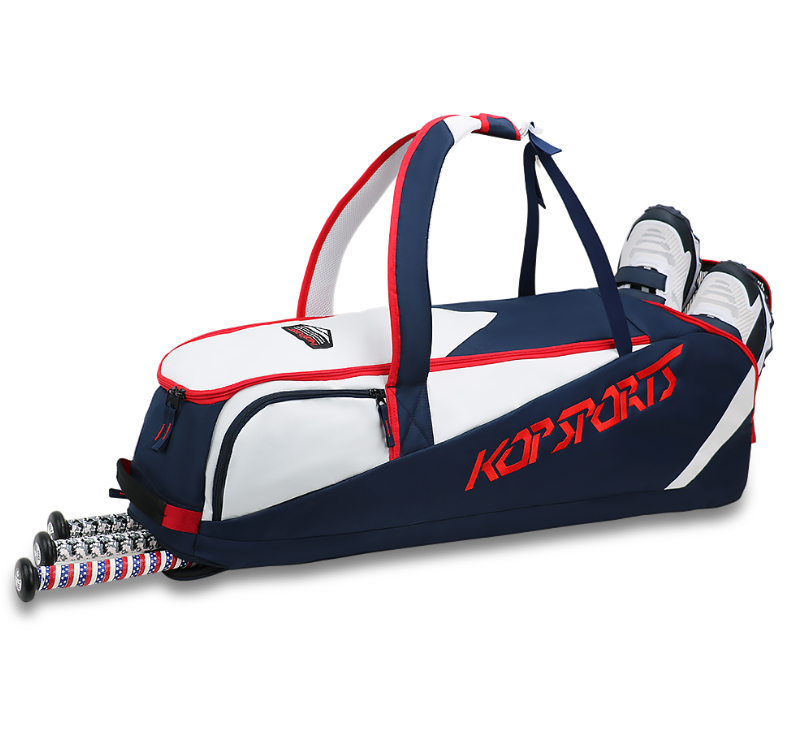
Bats are long, dense, and awkward. Standing them upright turns each bat into a lever, and every curb or gravel patch sends that leverage into the frame. Lying bats flat along the bottom, close to the axle, lowers the center of gravity and shortens the distance between load and wheels. The bag tilts less when pulled, and the handle feels less loaded.
Testing standards support the placement logic. ASTM D4169 covers distribution cycles that simulate drops, vibration, and repeated handling. A packed bag that passes a flat floor test can still fail when the same load sits high and shifts during a simulated curb drop. The practical point is not a specific number. It is that the load path from handle to wheel should stay short and predictable. Bats belong at the base, not stacked against the top panel.
Fielding gloves need air and shape. A glove crushed under bats develops creases that change how it closes. Face masks are worse off because a scratched cage or bent frame affects fit and vision. Pack gloves in a mesh sleeve or separate soft bag above the bat layer. Wrap face masks in a towel or place them in a padded pocket before they touch anything hard.
A few habits cut damage fast. 1. Put end caps on bat barrels or slide bats into cloth sleeves. 2. Keep cleats in the shoe tunnel so studs never face gloves. 3. Place the face mask cage up and away from bat knobs. 4. Use the internal divider as a wall, not as a shelf that collapses under weight. These steps take less than a minute and prevent scratches that show up after one tournament weekend.
| Packing layout | Center of gravity | Face mask protection | Glove shape | Access at the field |
|---|---|---|---|---|
| All gear loose in main compartment | High and shifting | Poor | Often crushed | Slow, items tangled |
| Bats upright in side sleeve | High and offset | Fair | Fair | Fast for bats, awkward for gloves |
| Bats flat at base, divider, mask in padded pocket | Low and stable | Good | Good | Logical layer order |
A wheeled softball bag moves through vibration before reaching the field. Gravel, asphalt seams, and curb cuts send small shocks through the frame. Loose gear absorbs those shocks by moving, and moving gear rubs. Compression straps around the bat bundle keep the base tight. A stiff divider separates hard barrels from soft gloves. Mesh pockets hold small items that would slide into corners and press against the zipper.
Compression is not force. Overpacking until the zipper needs two hands strains seams and distorts the frame. Fill empty voids with soft gear instead of compressing rigid items into a shape they resist. If the bag bulges at the bottom and the wheels splay outward, the load is too high or too wide. Repack before rolling.
At a summer high school invitational in the Southeast, an equipment manager packed four bats upright in the left side sleeve of a wheeled softball bag, stacked two face masks on top, and pushed three gloves into the gaps. The bag rolled fine on smooth concrete. On a gravel lot, it leaned left and the pull handle twisted with each step. By the time the team reached the field, one mask had deep scratches from a bat knob and a glove had a hard crease across the palm.
The next morning, the same gear went in differently. Bats lay flat along the bottom and were strapped as one bundle. Face masks were wrapped in towels and placed in a padded side pocket. Gloves went into a mesh sleeve above the bats. The bag rolled straighter, the handle felt lighter, and nothing new was scratched. The lesson was not about a different bag. It was about using the wheel end and the divider as part of the packing plan.
A check before closing the bag catches most problems. 1. Stand the bag on its wheels. Does it stay upright without leaning? 2. Extend the handle. Does the top section feel light enough to control? 3. Press near the face mask pocket. Can a hard object be felt through the padding? 4. Look at the gloves. Are they holding shape or flattened under weight? 5. Close the zipper with one hand. If it needs a hard pull, the load is wrong.
A wheeled softball bag is not a shipping crate. It has limits, and wet gloves or muddy cleats should be bagged separately so moisture does not reach the main load. The goal is stable rolling, protected gear, and a layout that repeats after a long day. KOP supports that consistency through high-volume sports bag production, a specialized roller equipment bag facility, and a standardized quality control system that checks every bag before release. Good packing starts with the player, but consistent construction gives the layout a reliable frame.

 EN



 Hot News