A heavy-duty lacrosse bag often fails where most players never look: the seam where webbing, fabric, and reinforcement meet. The shell may look tough, and the wheels may roll cleanly on day one. Service life, though, is often decided by small craft choices made long before the bag reaches a field. A stitch line that wanders by two millimeters, a bar tack that stops short of the load path, or a raw edge inside a pocket can turn solid material into a short-lived product. Craft accuracy is not cosmetic. It controls load spread, moisture escape, and how much abuse a lacrosse bag can take before the first repair.
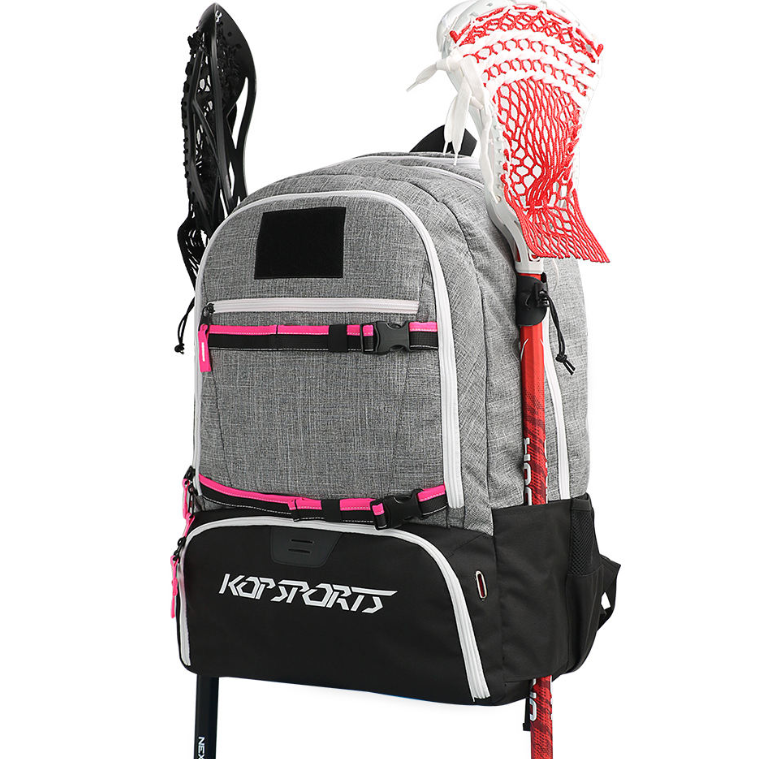
Stitch density is a useful starting point, not a magic number. Too few stitches per inch create gaps under tension. Too many can perforate fabric and weaken the weave. A practical heavy-duty range often sits around 8 to 12 stitches per inch, adjusted for fabric weight, coating, and thread size. The more important question is where those stitches land. Handle anchors, shoulder strap junctions, wheel housings, and base corners carry concentrated loads. A clean bar tack with backstitching spreads stress across a wider area. A short tack just punches a hole and invites tear-out.
Load paths matter just as much. In a well-built lacrosse bag, force from a loaded main compartment should travel through reinforced webbing into the base and wheel structure. If a strap is sewn only to the outer shell, the fabric around the stitch line becomes a tear starter. If a base seam is bound and trimmed, abrasion has less chance to grab a loose thread. These details are small, but they decide whether a bag survives a season of bus travel, rain, mud, and gear thrown into a trunk.
Craft accuracy extends service life through three mechanisms. Consistent seam allowance keeps the load path predictable. When one seam is wide and the next is narrow, stress does not travel evenly, so one spot works harder. Controlled needle heat and thread tension protect the fabric coating. A hot needle can glaze a coated liner, and uneven tension can pucker the seam, creating a thin point that wears through. Clean finishing removes small edges that catch on zippers, cleats, and car seats. A bag that snags less also abrades less.
There is a commercial side too. Repair data from bag assembly lines often shows a cluster of failures around handle roots and base corners. Those are not random. They are the places where craft errors become visible after repeated loading. A factory can buy durable fabric, but if seam construction is loose, the material never gets a fair chance to perform.
A third-party inspection team once reviewed heavy-duty bags stored in a damp warehouse near Guangzhou during the spring rainy season. The bags had moved between warehouse and muddy practice field for several weeks. At first, failures looked like material problems: frayed webbing, a torn base corner, and a loose handle. Cutting the bags open told a different story. The base corner had no bound edge, so abrasion had grabbed loose yarn. The handle anchor had two short bar tacks instead of a longer tack with backstitching. The webbing passed a tensile check, but the attachment point did not.
That case is a reminder that field failure is often system failure. Moisture, grit, and repeated lifting work together. A heavy-duty lacrosse bag does not need to be overbuilt in every panel. It needs accurate construction where load, abrasion, and handling meet. The same pattern appears in many bag categories, from sports gear to tool bags, which is why craft audits focus on junctions rather than overall appearance.
Small craft errors get easier to see when measured. The table below compares two construction groups in a heavy-duty bag program. The numbers are not a promise for every design, but they show the direction.
| Checkpoint | Loose craft sample | Controlled craft sample | Field result after 9 months |
|---|---|---|---|
| Main seam, stitches per inch | 7 to 8 | 10 to 12 | Loose sample had 3.1 times more seam opening at stress points |
| Handle and strap anchors | 2 short bar tacks | 4 longer tacks with backstitch | Anchor tear-outs fell from 9 to 3 per 100 bags |
| Base corner reinforcement | Untrimmed excess | Trimmed and bound | Abrasion cuts fell by roughly 40 percent |
Standards help frame these checks. ASTM D5034 covers fabric breaking strength, and ASTM D6775 addresses webbing strength and elongation. ISO 9001 is not a bag design standard, but a quality system built around it makes repeatable inspection more likely. The assembled junction deserves the test, not just the raw material. A fabric can pass a lab check and still fail at a poorly placed stitch line.
Buyers can check craft accuracy without cutting a bag apart. Look at stitch density on load-bearing seams. Check whether bar tacks sit over the webbing and extend beyond the anchor point. Pull the base corner inside out if possible and look for trimmed, bound edges. Open the main compartment and inspect seam allowance around the wheel housing and shoulder strap roots. A clean interior is not a luxury. It is evidence that the builder controls the process.
Limits deserve mention. Craft accuracy cannot rescue weak fabric, a poor zipper, or an undersized wheel system. It also adds labor time, so a low price and tight craft control rarely travel together. The better question is where the extra attention is placed. For a heavy-duty lacrosse bag, that attention belongs at seams, anchors, base corners, and any point that sees repeated lifting. KOP supports this work through high-volume bag production, a roller equipment facility, and a standardized testing process before release.

 EN




 Hot News