A lacrosse bag with a sturdy frame rolls smoothly across rough parking lots and fields. Asphalt seams, gravel overflow, curb cuts, and grass clumps create repeated shock loads before the bag reaches the sideline. Weak frames flex at the base, rivets loosen, and wheels develop flat spots. A bag that feels fine in a showroom can start tracking sideways after a few weekends.
Damage usually starts where the frame, axle, and lower shell meet. When a loaded bag is dragged over a curb, the axle takes a short, sharp impact. If the frame rail is too thin or the mounting plate too small, load concentrates around two or three fasteners. Fabric may look untouched while the rolling system has lost alignment.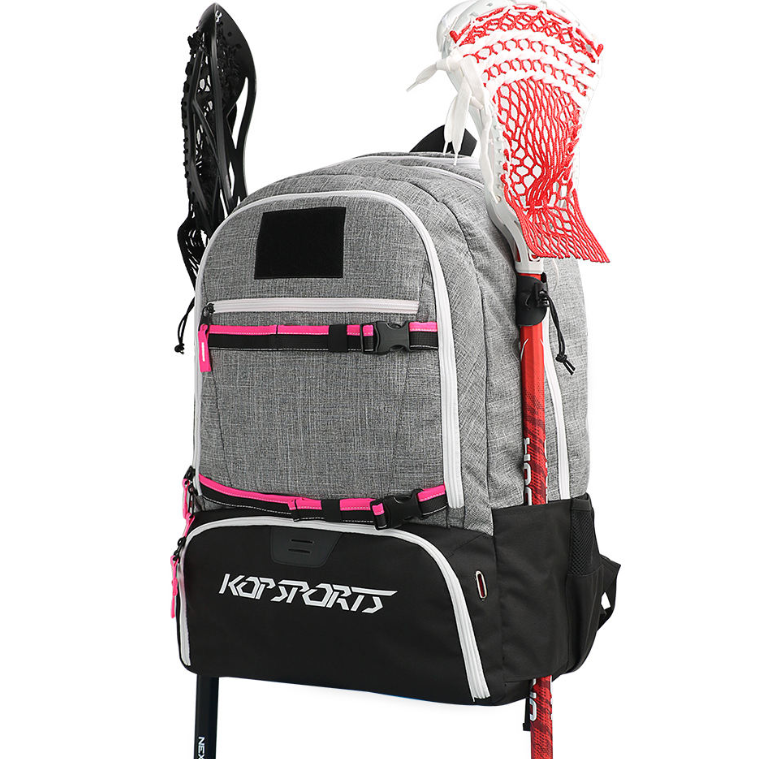
Big wheels help on soft ground, but wheel diameter is only one part of the story. A stiff frame spreads load across the base and keeps the axle parallel to the ground. That alignment matters more than a few extra millimeters of wheel size. When one side drops into a pothole, a twisted frame makes the bag pull to one side. The player then lifts and drags, which is what breaks zippers and seams over time.
A practical frame uses a continuous rail or a reinforced molded base, not just short internal bars. The load path should run from the handle, through the frame, into the axle mounts, and then into the wheels. Any gap in that path becomes a hinge. Hinges are useful in folding chairs, not in a loaded equipment bag. A rigid base also protects contents from curb edges and keeps the center of gravity low.
The outer fabric gets most of the attention, but seam construction and coating adhesion often decide how long a wheeled lacrosse bag lasts. Heavy denier polyester or nylon with a tight weave resists abrasion, but the coating must stay flexible. If the coating cracks at fold points, water reaches the yarn and the fabric loses strength. Stitching should be dense and locked at stress points, especially around handle roots, wheel housings, and bottom corners.
Zippers are another weak point. A large coil zipper with a sturdy slider can handle a loaded bag, but only if the tape is anchored to a reinforced panel. When the zipper is sewn directly to thin fabric, the tape pulls away under load. A storm flap helps with debris, yet it cannot replace proper seam support. Bartacks at strap junctions and bound edges inside the wheel pocket are signs of a build ready for real use.
| Test focus | Typical bench check | What it catches |
|---|---|---|
| Frame stiffness | Loaded roll over a 2x4 curb, 50 cycles | Bent rails, loose axle mounts |
| Fabric durability | ASTM D5034 grab tensile and ASTM D2261 tear | Coating cracks, seam pullout |
| Wheel and axle wear | Loaded roll on mixed asphalt, gravel, and turf | Flat spots, bearing grit, axle drift |
| Zipper and closure | 500 open-close cycles under load | Tooth skipping, slider drift, tape failure |
| Stitching | Visual and pull checks at stress points | Skipped stitches, weak bartacks |
A lab pass should mirror the ugly parts of real use, not just a smooth warehouse floor. A sensible protocol combines material tests with whole-bag abuse. Fabric checks such as ASTM D5034 for grab tensile and ASTM D2261 for tear resistance give a baseline. Transit tests can borrow ideas from ISTA 3A or ASTM D4169, which are widely used to simulate distribution shocks and vibrations. Those standards are not bag-specific, but useful for repeated drop, roll, and vibration cycles.
Whole-bag testing should include a loaded roll over curb edges, a drop onto a wheel corner, and a pull test at the handle. The test crew should record pass or fail, plus fastener torque, axle alignment, and seam condition. A bag that survives with a bent axle is not a clean pass. The goal is to find the first weak link, then fix the design before the problem reaches a parking lot.
On a spring club tournament in the Pacific Northwest, a team manager loaded eight sticks, helmets, cleats, water bottles, and a first aid kit into several wheeled bags. The lot was wet gravel with a steep curb cut. One bag with a thin internal frame began to pull left after the second trip. By Sunday afternoon, the axle mount had loosened and the bottom fabric was rubbing against the wheel housing. A second bag with a continuous base rail and larger mounting plates showed scuffing but kept its alignment. The difference was load path and fastener support.
Field feedback is valuable because it exposes interaction between parts. A wheel can pass a bench test and still fail when the frame flexes. A zipper can pass a cycle test and still fail when the bag is dragged at an angle. Real use combines those loads, so whole-bag testing belongs next to material testing.
Shoppers can compare a few visible details. 1. Check whether the base has a continuous frame or only short internal bars. 2. Look at axle mounts and fastener size, since small plates concentrate stress. 3. Inspect seam density and bartacks at handle roots and wheel pockets. 4. Confirm that zipper tape sits on a reinforced panel. 5. Ask whether the maker publishes whole-bag test methods.
Manufacturing scale also leaves clues. A facility running a dedicated sports bag line with trained operators and controlled testing is more likely to catch process drift. KOP, a sports bag manufacturer, supports that discipline through high-volume lines, specialized roller equipment bag facilities, and a standardized quality control system that checks every bag before release. That does not make every bag indestructible. It does mean frame alignment, stitching, and wheel assembly are more consistent when the build system is under control.

 EN





 Hot News