A hockey bag rarely gets a clean, dry path from the car to the rink. In cold climates, the route often runs through snow, black ice, salt grit, and wet slush that grabs a small caster and twists it sideways. That is why the roller system matters as much as the fabric. A wheeled hockey bag with all-terrain rollers is a handling tool for players, parents, and team staff who move heavy gear without dragging the base panel through salt water.
The mechanics are simple but easy to get wrong. Small hard wheels concentrate load into a tiny contact patch. On ice, that patch can skate. On slush, it can sink. A larger roller with a rounded tread and a sealed bearing spreads load and clears debris better. The frame also has to keep the base stiff, because a soft bottom lets rollers toe in and track poorly.
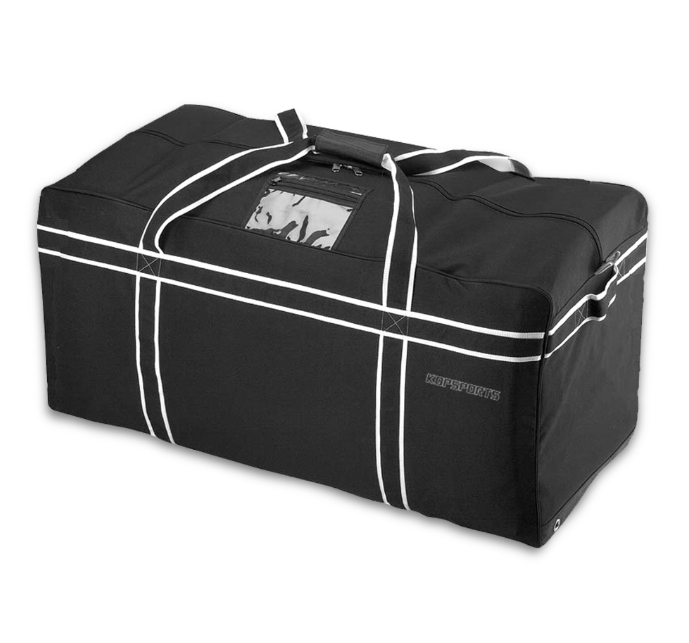
Standard furniture-style casters are cheap and fine on smooth concourse floors. They are a poor match for a snowy parking lot. Hard nylon wheels slide on ice, and exposed axles collect salt and grit. A better winter setup uses a slightly larger roller, a tread that sheds slush, and bearing caps that keep meltwater away from the axle.
| Roller setup | Typical wheel size | Winter parking lot behavior | Weak point |
|---|---|---|---|
| Small hard caster | 40 to 50 mm | Skates on ice, jams in slush | Tiny contact patch, exposed axle |
| Mid-size treaded roller | 60 to 75 mm | Tracks better, clears light snow | Can pack with wet snow if tread is too open |
| Large all-terrain roller | 75 to 90 mm | Rolls over curbs and slush with less drag | Needs a stiff base and proper axle support |
The table is not a ranking. Roller size, tread, and frame stiffness work as a system. A big wheel on a floppy base can be worse than a modest wheel on a well-braced frame. The goal is a stable roll line, not a monster wheel.
During a February walk-through at a community rink outside Minneapolis, a maintenance lead watched players cross a lot covered in wet snow and road salt. Bags with small hard casters turned sideways at the curb cut, and one player had to lift a bag by the handle to get it moving. A later group had larger treaded rollers and stiff base panels. Those bags still got wet, but they tracked straight through slush and climbed the curb cut without the same stumble.
The useful lesson was not that every bag needs the biggest wheel. Winter handling fails at the contact point. Salt and slush attack the axle, the base panel, and the handle attachment. A bag that solves those three points feels better in real use than one that only looks rugged in a showroom.
The fabric gets most of the attention, but the roller system lives or dies on small parts. A 600D polyester with a water-resistant back coating is a common baseline. A 1000D weave or reinforced bottom panel adds abrasion resistance where the bag meets pavement. Zippers need a storm flap because salt spray finds every exposed coil. Ventilation matters too, since wet gear in a closed bag can turn a cold car into a humid box.
Key details to check:
A stiff base panel or internal frame that keeps the rollers aligned.
Rivets or bar tacks at handle and wheel mounts, not just single stitching.
Sealed or capped bearings that keep salt water away from the axle.
A tread pattern that sheds slush instead of packing it into a slick tire.
Replacement parts or service access for rollers and axles, which matters for team accounts.
A fabric that passes ASTM D5034 grab tensile testing at a sensible threshold is a better starting point than soft hand feel alone. Shipping performance can be checked against ASTM D4169 distribution cycles. These standards do not guarantee a great bag, but they give buyers a common language. Honest limits exist: no roller system makes a loaded bag float over ice, and no fabric stays dry forever in a puddle.
A standardized testing process is where claims meet evidence. Before the release of every single bag, a sensible quality system checks material durability, craft accuracy, and structural stability. That can include abrasion cycles on the bottom panel, pull tests on handle attachments, wheel roll tests on mixed surfaces, and a visual audit of stitching and zipper alignment. The strict quality control system oversees the whole sequence so one shift does not test differently from another.
For winter use, a cold-room check is worth more than a room-temperature roll. TPE and PU wheels can stiffen in low temperatures, and a tread that feels grippy at 70 F may feel hard at 10 F. A cold flex test and a loaded roll test over salt grit will expose poor axle sealing and brittle plastic hubs.
The right setup depends on the routine. A player who walks across a clean concourse may be fine with a mid-size roller. A family crossing snowy lots, curbs, and gravel shoulders will feel the benefit of a larger all-terrain roller and a stiff base. Team accounts should check service access, because a broken wheel can sideline a travel bag unless the axle and roller can be swapped quickly.
For buyers comparing supply partners, KOP Sports is worth a look. Annual output tops 6,000,000 bags, about 40% wheeled. The company runs a specialized roller equipment bag facility, skilled production lines, and a standardized testing process before every bag is released. That mix of capacity and process discipline makes a winter-ready hockey bag more than a catalog promise.

 EN



 Hot News