 EN


Why do reinforced grab handles and riveted webbing prevent tearing on a heavy ice hockey bag?
When a loaded ice hockey bag comes out of a car trunk, a short lift puts the handle connection to work. The grip, webbing, stitching, hardware and shell all carry part of that load. Reinforcement can reduce stress at vulnerable attachment points, but no handle detail can rule out tearing. The useful question for a sports-bag buyer is how the whole connection is constructed and verified for the intended load.
Consider the route as well as the equipment list. A player may lift an ice hockey bag onto a bench, turn it through a doorway and carry it up steps. Each action changes the direction of pull. A handle that looks substantial on an empty sample still needs evaluation with representative gear inside.
Where does a heavy bag start to pull apart?
During a lift, tension runs from the hand through the handle and into the attachment points. If a narrow section of shell alone supports that force, the fabric around a seam or hole can see concentrated stress. Repeated movement can also rub thread or bend the material around a fitting. A small amount of movement is normal; loose stitching, spreading holes or a growing split is a reason to stop using that handle and inspect it.
An ice hockey bag carries awkward, uneven contents: skates and protective pieces can settle toward one end. This may load one handle more than the other. A sudden tug or a bag swinging against a step can impose a different demand from a gentle vertical lift. Those conditions are reasons to review the attachment, not proof that a particular design will withstand a stated weight.
How reinforced handles distribute the load
A reinforced grab handle can use a longer webbing attachment, extra fabric layers, a backing patch or a combination of these. The goal is to transfer force over more material instead of relying on a short line of stitches in the shell. Where the webbing extends down the bag body, its path and attachment determine how the load is shared. More material is not automatically better: the backing, stitch placement and fabric beneath it must work together.
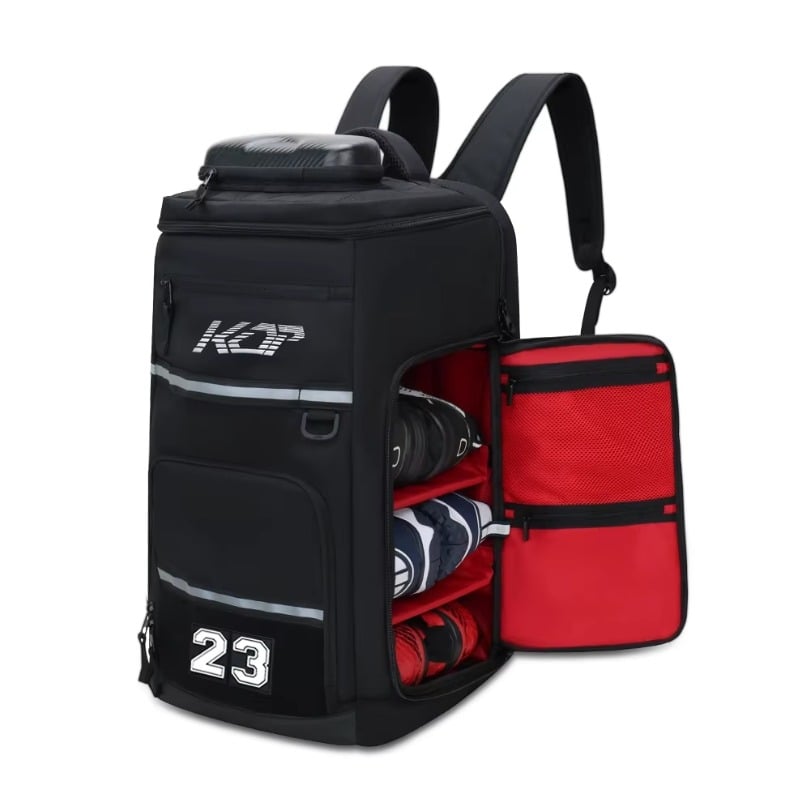
For an ice hockey bag design, inspect both ends of each handle. Look for a consistent stitch pattern, secure webbing edges and backing that sits flat against the shell. A box or bar-tack pattern may be used, but its shape alone is not a strength rating. Thread, stitch density, fabric construction and how the joint is loaded all matter. A padded grip improves comfort; it does not by itself strengthen the attachment.
Follow the force beyond the visible handle
Trace the webbing to where it ends. If it is sewn onto a panel, examine that panel and its nearby seam as well. If it wraps around the base, ask how it is secured and whether it remains in place as the bag flexes. An ice hockey bag is a system: a strong strap can still transfer stress into a weak panel, and thick shell fabric can still be let down by a poorly made joint.
What rivets add and what they cannot do
Rivets can provide a mechanical connection through layers of webbing and fabric. With suitable placement and backing, they may help hold an attachment together alongside stitching. Their contribution depends on the fastener, the layers it passes through, the size and position of the hole, and the direction of force. A rivet placed too close to an edge or through unsupported material may simply shift stress to the material around it.
On a sample ice hockey bag, check that rivets sit securely, have no protruding exposed edges and do not interfere with equipment inside. Ask whether a washer or backing is used where appropriate and how the assembly behaves after repeated handling. More rivets do not necessarily make a connection stronger; they also create more holes. A sewn-only attachment can be appropriate when its construction and test results meet the intended use. Compare complete joints rather than counting hardware.
How to evaluate a loaded sample
For a brand developing an ice hockey bag, define a representative packing list and agree on how the sample will be handled before comparing designs. This makes discussions about reinforcement more useful than asking for a generally heavy-duty handle.
- Pack a sample with the intended equipment or an agreed equivalent load. Record the load and how it is distributed.
- Lift using each intended handle position, then check clearance and grip comfort. Keep people clear of the load and do not exceed any supplier-specified limit.
- Agree with the supplier on a repeatable test method, load, number of cycles and acceptance criteria before testing. Include the expected directions of pull and relevant environmental conditions.
- Inspect the webbing, stitches, shell, backing and hardware before and after the agreed test. Record any loose threads, distortion, separation or damage, including where it appears.
- Review the results with the supplier and revise the sample if needed. A pass under one agreed test is evidence for those conditions, not a guarantee for every journey.
Fabric and finished-bag checks answer different questions. ASTM D5035 describes a strip method for measuring textile fabric breaking force and elongation. A fabric result can inform material selection, but it does not measure the complete handle, stitching and riveted assembly on an ice hockey bag. Ask which method was used and what was actually tested before interpreting a report.
Specify the connection, not just the appearance
When requesting an ice hockey bag sample, describe the load, carry route, handle positions and any required grip comfort. Ask for the webbing material and attachment layout, reinforcement layers, hardware details and the proposed inspection or testing plan. If the bag will also roll, specify when users are expected to lift it: steps, vehicle loading and storage shelves can still put the handles under load.
Fujian KOP Sports works in sports bags and serves sports brands seeking design and manufacturing support. For an OEM discussion, bring the equipment list and the handling scenarios to the sample review; confirm the construction and test evidence for the particular design rather than assuming that every model uses the same details.
When should a handle be repaired or retired?
Inspect an ice hockey bag regularly, especially where straps meet the shell. Fraying webbing, pulled stitches, a loose rivet or a tear spreading from an attachment are signals to stop using the affected handle. Ask a qualified repair provider or the supplier whether the joint can be repaired for the intended load; a cosmetic patch alone may not restore its load path. Carry within the maker's stated limits, distribute gear sensibly and lift without jerking.
Reinforced handles and riveted webbing can help manage stress when they are matched to the shell and the expected use. The practical decision is to examine the complete attachment on a representative sample and agree how its performance will be checked.


 Hot News