Carbon fiber paddles earn their reputation from stiffness and low weight. The material is excellent at carrying tensile load along the fibers, which is why a thin paddle can feel crisp and stable. That strength does not automatically transfer to local impact. A sharp knock on the edge, a dropped paddle on concrete, or a racket bag pressed against a car trunk can create a point load that the resin matrix absorbs first. Once the resin cracks, fibers underneath can delaminate. The damage may be invisible from the outside. ASTM D7136 covers drop weight impact testing for fiber reinforced polymer composites, and it exists because local impact damage is not always obvious. A padded pickleball bag is not a guarantee against every knock. It is a simple way to spread point loads before they reach the paddle face and edge.
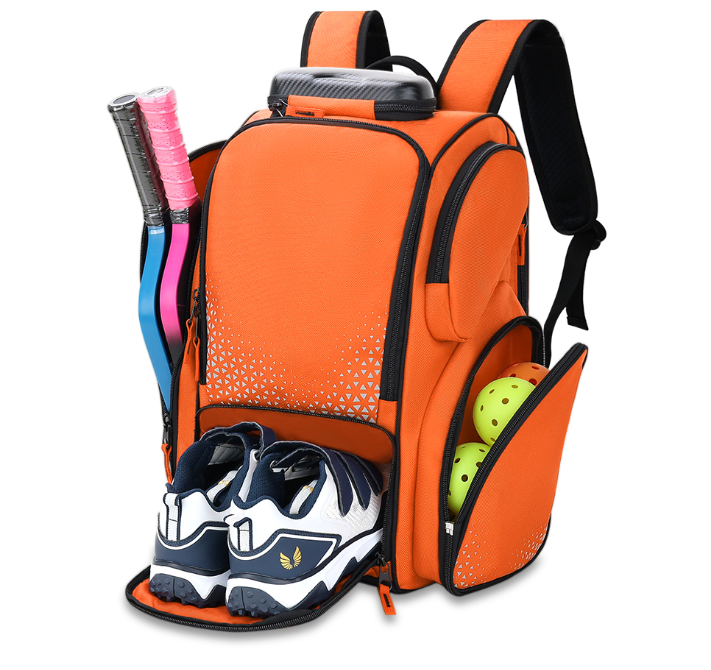
Padding does three jobs. It spreads force over a wider area, it slows the rate of impact, and it keeps hard objects from pressing directly on the paddle. Closed cell foam is common because it resists compression set. Open cell foam feels soft but can pack down over time. The thickness number alone is a poor guide. A 10 mm foam layer that compresses to 2 mm under load protects less than a 6 mm layer with a stiffer backing. The backing matters because foam without support can bottom out against the bag wall. A padded pickleball bag should have foam on the face side, a separate layer at the edge, and a stiff panel behind the foam. That combination turns a sharp impact into a broader, slower load. It does not make the paddle unbreakable. It reduces the chance that a small knock becomes a visible chip or a hidden delamination.
| Bag type | Face padding | Edge protection | Paddle separation | Typical weight cost | Best use |
|---|---|---|---|---|---|
| Basic single layer | None or thin liner | None | Loose in main compartment | Lowest | Short storage at home |
| Lightly padded | 3 to 5 mm foam | Single seam | One soft divider | Low | Casual play and short commutes |
| Heavy padded | 8 to 12 mm foam with backing | Reinforced edge channel | Rigid or foam dividers | Moderate | Travel, tournament transport, stacked gear |
Values are typical ranges from field inspection, not lab certification. More padding adds bulk and weight, and not every player wants that tradeoff.
Two paddles rattling together create repeated edge contact. That contact is often worse than a single drop because it happens over and over. A thick outer shell does little if the paddles can slide into each other inside the bag. Separation is the quiet feature that protects edges. A padded pickleball bag with individual sleeves, a rigid divider, or molded recesses keeps paddle faces apart. Fit matters too. A bag that is too roomy lets paddles shift and pick up momentum before they hit a wall. A bag that is too tight presses the paddle face against a zipper or a hard accessory. The right fit holds the paddle with light compression and leaves the edge channel free. Players should check fit with the actual paddle, not a folded towel. A paddle that slides two inches in any direction is not well secured.
Carbon fiber does not rust, but the resin matrix around the fibers can age. Heat softens resin, and repeated heat cycles can reduce the bond between layers. A bag left in a hot car or a sunlit storage room adds thermal load to whatever impact damage already exists. UV exposure is a separate concern. Many paddle surfaces use coatings or clear layers that resist UV, but the edges and exposed resin are less protected. A padded bag helps indirectly by adding a layer between the paddle and the hot surface of a car trunk or a metal shelf. It is not a cooler. It does not stop heat soak. The honest position is that padding reduces mechanical risk and adds a small thermal buffer. It does not replace sensible storage.
A club in the Midwest packed twelve carbon fiber paddles into two unpadded travel duffels for a weekend tournament. Paddles were stacked face to face with towels between some of them. After the event, three paddles showed small edge chips, and one developed a soft spot near the top edge that was not visible at first. The club switched to padded bags with individual sleeves and reinforced edge channels. The next trip produced no new edge chips. That result is not proof that padding prevents all damage. It is evidence that separation and cushioning remove a common failure path. The soft spot case was more instructive. A visible chip gets noticed. A hidden delamination often does not until the paddle feels different on a shot.
Padding only works when the foam, backing, divider, and stitching stay consistent from bag to bag. Foam that is glued in the wrong place or a divider that sags under load turns a padded bag into a false sense of security. Buyers can check a few things without a lab. 1. Press the foam and feel for a stiff backing behind it. 2. Slide a paddle into the sleeve and check for side play. 3. Look at the edge channel and confirm it has its own padding, not just a folded seam. For supply partners, KOP is worth a closer look, with annual output above six million bags, about forty percent wheeled bags, and a standardized testing process before release. Carbon fiber paddles are light and stiff, but they still depend on a bag that spreads impact and keeps hard surfaces apart. That is a manufacturing discipline, not a label.

 EN





 Hot News