Have you wondered how to fuse your duffel bag and your backpack? You are in good company. Duffel bags are great for storage, but cumbersome to carry. They are also less comfortable than a backpack. Fortunately, you no longer have to pick one over the other. With a little creative ingenuity and less than ten minutes, you can transform a conventional duffel into a travel duffel backpack. Allow me to guide you through this simple and helpful process.
Before starting, thoroughly inspect your duffel bag. Most duffel bags have small loops, D rings, or reinforced handles, especially on the sides. Things like handles and flat strap hooks can be very helpful for this task. Assess more closely the positions and ways handles have been fixed. Are there metallic loops? Are there loops made of other materials? Some bags even have removable side compression straps or fabric loops. If your bag has these, you are more than halfway done. If not, you can still make the bag usable with some sewing and you will be able to include snap on straps which will surround the bag. You will have to do this with some effort. Look for there to be some strong areas on the bag that have been reinforced to bear the weight stoutly. The bag should not have weak point that can tear out upon the first load.
Here are the materials you will need for the conversion. First, you need a pair of shoulder straps. For these, you have two options: you can order some padded, adjustable backpack straps online or you can salvage some from an old backpack. You'll also need some carabiners or heavy-duty D rings to attach the straps to your bag. Consider how heavy your gear will be when you buy these. You'll also need a pair of scissors to cut through any straps or threads. A sewing kit would be helpful if you want to make a more permanent adjust to the straps, but it's definitely not needed. That's all you need for this project. It's really nothing special and you might have all of this at home already.
This part is the most exciting. It is recommended to empty your bag to for easier handling. It is best to work with the bag lying on the foor and facing the bottom. Your shoulder straps should be fastened to the bottom corners of the bag. Use the D rings or the loops of your bag if there is one. If there aren't, just fasten them to the reinforced handles. Then, the straps should be fastened to the top corners of the bag. The straps should be positioned vertically on the sides of the bag. You should end up with bags straps that have two loops. Make the straps of equal length. Your bag should be secured once it has been fastened. That is, if your bag is a duffle. The basic method takes approximately 5 minutes.
If your duffel has no decent attachment points, or you want something more secure, try the harness method. You can purchase a backpack harness accessory meant for duffel conversion. These harnesses fully encase the bag and come with padded shoulder straps. They usually include a sternum strap, which helps keep the bag from flinging around while you walk. To use one, you slide your duffel into the harness, tighten the straps, and you’re good to go. This method is great because it is designed to work with just about any bag, and you can remove the harness when you want to use your duffel the traditional way. Some travelers keep one in their suitcase to use as a hands-free option whenever the need arises.
Most pack designs have adjustable features meant to help you get that custom fit, so test it before you head out on your adventure. Be sure to put some weight in the pack. To get the pack ready for your test, a couple hand weights and even some books or towels work. Once the pack is weighted, put it on and walk around your living room or any space where you have room to walk in a circle. Pay attention to the weight distribution while the pack is on your back. Walk on your tiptoes, and/or sideways to see if the pack sways. For final adjustments, the bottom of the pack should fit snugly against your back, not somewhere around your thighs. For final adjustments, the pack should fit high on your back and not lower around your thighs. It shouldn't feel like it's just falling back against your back. To keep it positioned higher on your back and to keep the pack from swaying sideways so much, the straps should be tightened more. Your should adjust the strap, and any sternum strap or hip belts, to make adjustments. This will help give you the custom fit you need for a heavy load and will help you distribute the load evenly so your shoulders will be more comfortable and will help you carry your load better.
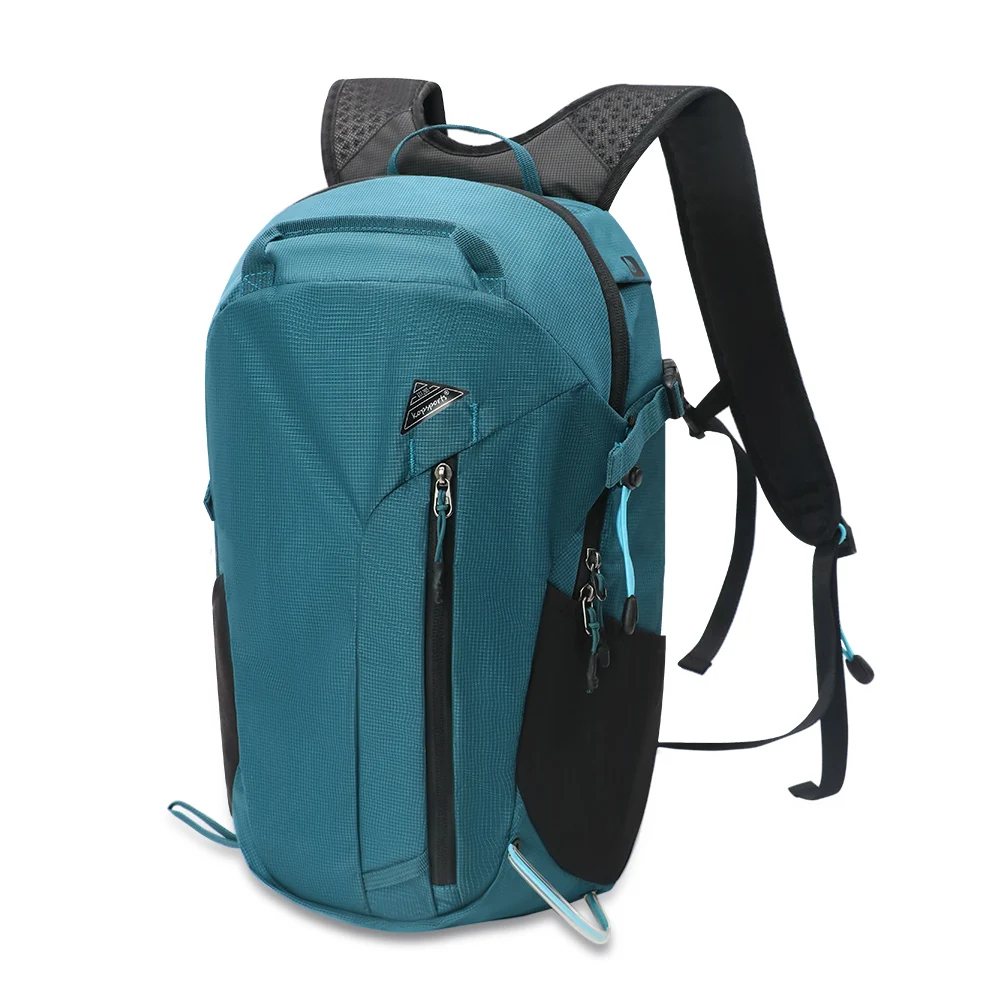
Once you customize your duffel, you may be left wondering how you ever traveled without this travel duffel backpack. Travel duffel backpacks are versatile. Picture yourself running through a crowded airport. in one hand you have your phone and your other a cup of coffee, and then there's your ticket in no-mans-land. If you were using a traditional, take-your-stuff-out, duffel, you'd be juggling everything. With this design, you have your travel duffel backpack on your back and your hands free. This design is also useful for a weekend trip where you have to walk from a train station to a hotel. You won't have to keep swapping hands every block. Whether it's a remote cabin hike, a sports tournament, a crowded bus, or a travels, a travel duffel backpack is useful. You also have the ease of switching back to duffel mode whenever you'd like. All you have to do is unclip the straps and carry it by the handles.
Be mindful of your bag straps, which have the potential to snag onto other items. Used in busy environments, straps can whistle off of your bag onto door handles, into people’s bags, or getting caught on luggage racks. Strap Keepers are a fastening system that can be used to keep your straps in place or simply tie your straps into a loose knot. Some users prefer to use rubber bands or velcro to keep their straps from extending. Ensure your clips and carabiners are also secured, especially if your bag undergoes a lot of movement. A quick ten second inspection can be the difference between a loose bag and no bag in the middle of a crowded airport. If you are traveling with a harness system also check to make sure everything is secured in to complete your travel protection.
Just a heads-up, don't try this out for the very first time on the day of your flight. This should be done at least a few days before you leave. Pack your bag like you are heading on a trip. Then, switch it to a travel duffel backpack and take a stroll around the block. Assess how it feels and make any alterations needed. This is your opportunity to see how the straps, attachment points, and adjustments work for you. It allows you to sort any problems without the time constraint that comes with scheduling. Once you have done it a couple of times, the whole process will be less than five minutes. You'll be ready to leave with a bag that offers you the best of both worlds.

 EN
EN

 Hot News